The Skatalites: Ska Boo Da Ba 12"
I met the Chinese-Jamaican record producer Philip Stanford ‘Justin’ Yap in August 1991 in Queens, New York, where he was working, driving a taxi. In person Justin was a warm, friendly man who loved music and good Chinese food, and we spent a few days together talking about his music and his life in Kingston and the USA.
In the early 1960s Justin and his brother Ivan [aka ‘Jahu’] ran the Top Deck sound system from their family’s ice cream parlour and restaurant in Barbican, Kingston. The local success of the sound system encouraged them to venture into the recording business, and by 1962 Justin had recorded singers Larry Marshall, Ephraim ‘Joe’ Henry and Ferdie Nelson. The fledgling label recorded a couple of tunes with Larry Marshall and trumpeter Baba Brooks. “Distant Drums” by Brooks and the Trenton Spence Orchestra was a version of the old Cuban composition by Ernesto Lecuona, called “Jungle Drums” [originally “Canto Karabali”, recorded in 1928]. The label enjoyed a modest local Jamaican hit in 1963, when issued on Top Deck Records as the b-side to Larry Marshall’s hit “Too Young To Love”. As a fan of easy listening musician Martin Denny, Justin had heard “Jungle Drums” on Denny’s 1959 LP “Afro-Desia”. His liking for Martin Denny would prove fruitful later, when Justin recorded the Skatalites in a mammoth all-night session in 1964 at Clement Dodd’s Studio One on Brentford Road. The site had formerly been the location of a jazz club called ‘The End’.
By 1963-1964, hundreds of ska tracks were being recorded by Clement Dodd, Arthur ‘Duke’ Reid, Vincent Edwards, Vincent Chin, Leslie Kong and Prince Buster and others. Justin had linked up with Allen ‘Bim Bim’ Scott, a friend of Clement ‘Coxson’ Dodd, owner of the Studio One label who had already recorded the musicians who became the Skatalites. Through Scott, Justin met the Skatalites: “[Scott] started to say, well, you could get the Skatalites band, which was on fire at the time. Then he got me introduced to Roland, [Alphonso] Johnny Moore, the basic band at the time, Knibb and everybody. And then we hook up with Don Drummond too. I call him maestro. He takes over. He’s in charge. He knows what he’s doin’ – he’s very professional. And when you hear my recordings with Drummond, you know he’s in charge. I remember when I drove Bim downtown, we drove to his house. First of all, I didn’t go in – Bim went in and talked to him first. I remember he took off! Just went down the road and come back with his answer – it’s OK.”
Justin and brother Ivan organised the session in November 1964 at Studio One; it lasted 18 hours. Justin and Ivan had laid on food, drink and ganja: as Justin told me “This was a monster session and it turned out the greatest recording for me. One night session, one long jam session; it was like a party!” Justin was not only scrupulous about prompt payment for the musicians and singer Jackie Opel – he actually paid double the going rate.
The length of the session also allowed for alternate takes to be recorded, but the highlights of the sessions were the five original compositions by Don Drummond – “Marcus Junior”, “The Reburial”, “Confucious”, “Chinatown” and “Smiling”. The first two are in tribute to the Pan-Africanist Marcus Garvey; “The Reburial” refers to the occasion of his interment in Jamaica in 1964, his remains having been brought from the cemetery in Kensal Green London, where he was originally buried in 1940, and reburied in King George VI Memorial Park Kingston [later renamed National Heroes Park].
Along with these originals were some well-chosen cover versions. Two came from the Duke Ellington book: “Ska-Ra-Van” is of course Duke Ellington and his trombonist Juan Tizol’s classic composition “Caravan”, while “Surftide Seven” is Ellington’s “In A Mellotone”. The LP title track “Ska-Boo-Da-Ba” is a version of Bill Doggett’s 1958 “King” US 45 “Boo-Da-Ba”. “Ringo” had also appeared on Arthur Lyman’s “Taboo” LP [1958] where it’s titled “Ringo Oiwake”. Originally it was sung by Hibari Misora – a very famous vocal song in Japan, recorded in 1952, the melody composed by Masao Yoneyama. Yet another tune copped from Lyman’s “Taboo” LP is “China Clipper”, composed by the pianist / arranger / orchestrator Paul Conrad, best known for his arrangements for 1950s English ballad singer David Whitfield. Incidentally, Conrad also recorded a classic easy listening set called “Exotic Paradise” in 1960, which fetches big money from collectors of that much-maligned ‘exotic’ genre.
The last track on this fine LP is “Lawless Street”, a feature for Roland Alphonso. Unlike the other Skatalites, Roland wasn’t a graduate of the celebrated Alpha School, like many of Jamaica’s top musicians from Bertie King to Yellowman. Alphonso was a graduate of Boys Town School in Denham Town. “Lawless Street” was another tune that was recorded twice at the session – the second version features vocal ‘peps’ and exhortations by DJ King Sporty.
The following year, the Skatalites again recorded for Justin at Clement Dodd’s Studio One and at the studio of the Jamaica Broadcasting Corporation [JBC]; from these sessions came tunes like “Red For Danger” and “Yogi Man”. Justin’s last session produced further brilliant cuts with Roland Alphonso – a superb version of jazz pianist Ray Bryant’s “Shake A Lady” and a hypnotically relentless version of Henry Mancini’s theme for the Peter Sellers film “A Shot in The Dark”. He also issued a great LP by the soulful Bajan singer Jackie Opel.
By late 1966, Justin emigrated to the USA, settling permanently in New York. There he took up US citizenship and was called up to serve in the US Army in Vietnam, In the early 1970s he worked in computers and eventually drove a New York cab. In his all too brief involvement in the competitive Jamaican music business he certainly left his mark as a producer. He produced some of the best ska ever made, and the LP reissued here is perhaps the most coherent LP in that genre, deriving as it does from a single session.
The celebrated record producer at Randy’s Studio, Clive Chin, who actually introduced me to Justin in the summer of 1991, had this to say to writer Heather Augustyn:
“It wasn’t the fact that they [the musicians] really love Justin; it was the fact that Justin used to pay them the right money and make them comfortable. Make sure them have them smoke, them food, them drink, and after them finish they got paid.” Unlike many other producers, Justin actually attended the sessions.
On a personal note, I was working in Spain during 1966- 1969 when the LP was released in the UK on Doctor Bird Records. What actually got me listening to the record again – in particular the Drummond compositions – was a concert I attended in late 1969 at the Lyceum in central London, performed by the jazz-rock band ‘East Of Eden’. During that concert they played an extended version of “Marcus Junior”. At first the rock treatment – led by electric violin and soprano sax – confused me. Then when that group issued a single with “Marcus Junior” as the b-side of their UK hit “Jig-A-Jig” on UK Deram, I bought that record, and there was the correct composer credit of ‘Drummond’ on the label. It sent me straight back to the original Doctor Bird LP.
In the late 1990s Justin was diagnosed with liver cancer, and although he’d returned to Jamaica, he travelled often to the US for treatment. During the time I spent with Justin, we had many conversations about music and life – as I noted earlier he was a warm and friendly guide to New York. Through Justin I got to know a great Chinese restaurant on the Bowery, where I had the best Chinese style spare ribs and cabbage I’ve ever tasted. I was also happy to find in Kingston the original tape of “Distant Drums” which I was able to return to Justin in early 1993. In conclusion I’m still grateful for everything he showed me – his kind personality, fascinating conversation and most of all, for the great music he produced. It stands as his defining legacy in Jamaican music history.
- Label: Pressure Sounds
- Format Type: 12"
- Genre: reggae
Product Information
Product Information
Shipping & Returns
Shipping & Returns
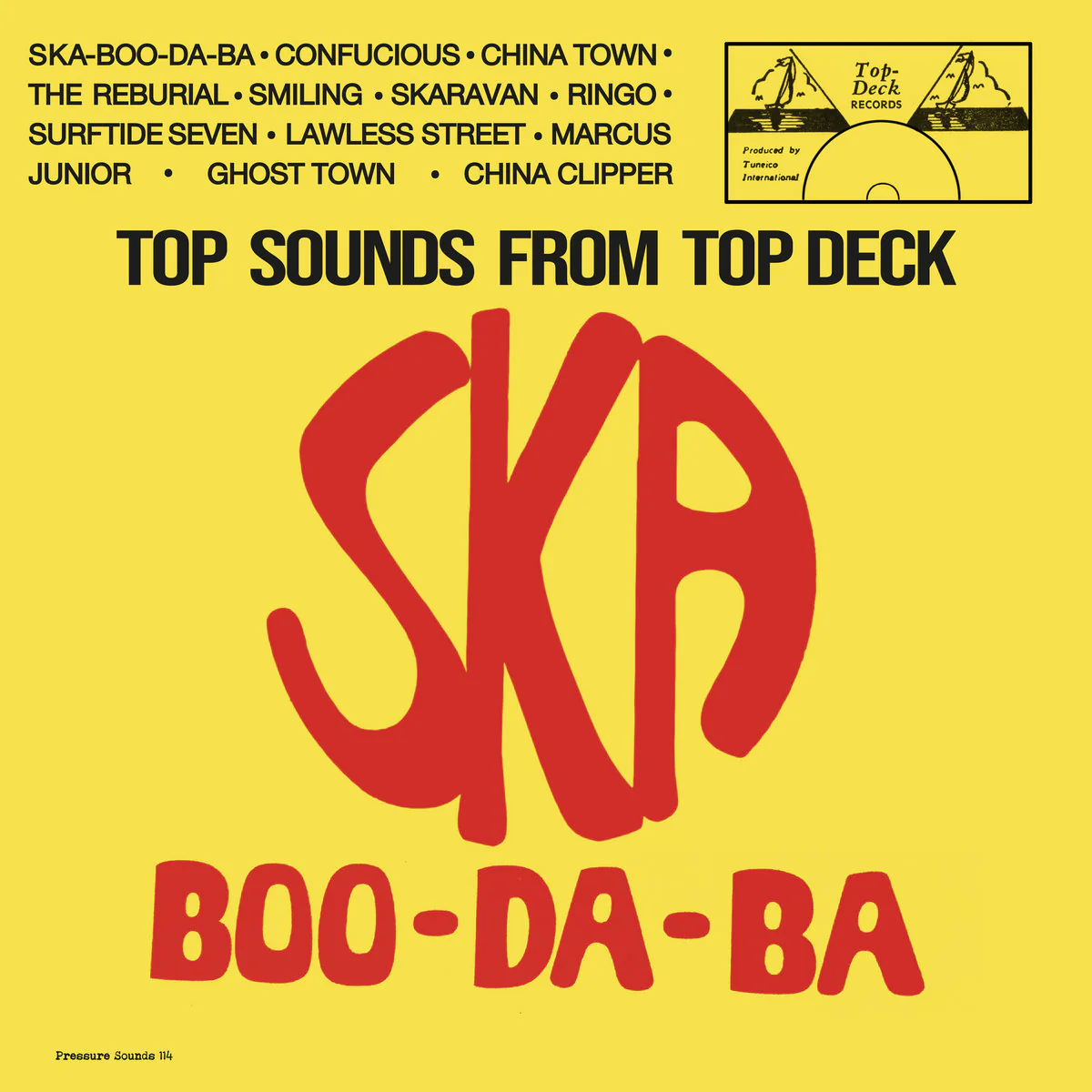
The Skatalites: Ska Boo Da Ba 12"
The Skatalites: Ska Boo Da Ba 12"
I met the Chinese-Jamaican record producer Philip Stanford ‘Justin’ Yap in August 1991 in Queens, New York, where he was working, driving a taxi. In person Justin was a warm, friendly man who loved music and good Chinese food, and we spent a few days together talking about his music and his life in Kingston and the USA.
In the early 1960s Justin and his brother Ivan [aka ‘Jahu’] ran the Top Deck sound system from their family’s ice cream parlour and restaurant in Barbican, Kingston. The local success of the sound system encouraged them to venture into the recording business, and by 1962 Justin had recorded singers Larry Marshall, Ephraim ‘Joe’ Henry and Ferdie Nelson. The fledgling label recorded a couple of tunes with Larry Marshall and trumpeter Baba Brooks. “Distant Drums” by Brooks and the Trenton Spence Orchestra was a version of the old Cuban composition by Ernesto Lecuona, called “Jungle Drums” [originally “Canto Karabali”, recorded in 1928]. The label enjoyed a modest local Jamaican hit in 1963, when issued on Top Deck Records as the b-side to Larry Marshall’s hit “Too Young To Love”. As a fan of easy listening musician Martin Denny, Justin had heard “Jungle Drums” on Denny’s 1959 LP “Afro-Desia”. His liking for Martin Denny would prove fruitful later, when Justin recorded the Skatalites in a mammoth all-night session in 1964 at Clement Dodd’s Studio One on Brentford Road. The site had formerly been the location of a jazz club called ‘The End’.
By 1963-1964, hundreds of ska tracks were being recorded by Clement Dodd, Arthur ‘Duke’ Reid, Vincent Edwards, Vincent Chin, Leslie Kong and Prince Buster and others. Justin had linked up with Allen ‘Bim Bim’ Scott, a friend of Clement ‘Coxson’ Dodd, owner of the Studio One label who had already recorded the musicians who became the Skatalites. Through Scott, Justin met the Skatalites: “[Scott] started to say, well, you could get the Skatalites band, which was on fire at the time. Then he got me introduced to Roland, [Alphonso] Johnny Moore, the basic band at the time, Knibb and everybody. And then we hook up with Don Drummond too. I call him maestro. He takes over. He’s in charge. He knows what he’s doin’ – he’s very professional. And when you hear my recordings with Drummond, you know he’s in charge. I remember when I drove Bim downtown, we drove to his house. First of all, I didn’t go in – Bim went in and talked to him first. I remember he took off! Just went down the road and come back with his answer – it’s OK.”
Justin and brother Ivan organised the session in November 1964 at Studio One; it lasted 18 hours. Justin and Ivan had laid on food, drink and ganja: as Justin told me “This was a monster session and it turned out the greatest recording for me. One night session, one long jam session; it was like a party!” Justin was not only scrupulous about prompt payment for the musicians and singer Jackie Opel – he actually paid double the going rate.
The length of the session also allowed for alternate takes to be recorded, but the highlights of the sessions were the five original compositions by Don Drummond – “Marcus Junior”, “The Reburial”, “Confucious”, “Chinatown” and “Smiling”. The first two are in tribute to the Pan-Africanist Marcus Garvey; “The Reburial” refers to the occasion of his interment in Jamaica in 1964, his remains having been brought from the cemetery in Kensal Green London, where he was originally buried in 1940, and reburied in King George VI Memorial Park Kingston [later renamed National Heroes Park].
Along with these originals were some well-chosen cover versions. Two came from the Duke Ellington book: “Ska-Ra-Van” is of course Duke Ellington and his trombonist Juan Tizol’s classic composition “Caravan”, while “Surftide Seven” is Ellington’s “In A Mellotone”. The LP title track “Ska-Boo-Da-Ba” is a version of Bill Doggett’s 1958 “King” US 45 “Boo-Da-Ba”. “Ringo” had also appeared on Arthur Lyman’s “Taboo” LP [1958] where it’s titled “Ringo Oiwake”. Originally it was sung by Hibari Misora – a very famous vocal song in Japan, recorded in 1952, the melody composed by Masao Yoneyama. Yet another tune copped from Lyman’s “Taboo” LP is “China Clipper”, composed by the pianist / arranger / orchestrator Paul Conrad, best known for his arrangements for 1950s English ballad singer David Whitfield. Incidentally, Conrad also recorded a classic easy listening set called “Exotic Paradise” in 1960, which fetches big money from collectors of that much-maligned ‘exotic’ genre.
The last track on this fine LP is “Lawless Street”, a feature for Roland Alphonso. Unlike the other Skatalites, Roland wasn’t a graduate of the celebrated Alpha School, like many of Jamaica’s top musicians from Bertie King to Yellowman. Alphonso was a graduate of Boys Town School in Denham Town. “Lawless Street” was another tune that was recorded twice at the session – the second version features vocal ‘peps’ and exhortations by DJ King Sporty.
The following year, the Skatalites again recorded for Justin at Clement Dodd’s Studio One and at the studio of the Jamaica Broadcasting Corporation [JBC]; from these sessions came tunes like “Red For Danger” and “Yogi Man”. Justin’s last session produced further brilliant cuts with Roland Alphonso – a superb version of jazz pianist Ray Bryant’s “Shake A Lady” and a hypnotically relentless version of Henry Mancini’s theme for the Peter Sellers film “A Shot in The Dark”. He also issued a great LP by the soulful Bajan singer Jackie Opel.
By late 1966, Justin emigrated to the USA, settling permanently in New York. There he took up US citizenship and was called up to serve in the US Army in Vietnam, In the early 1970s he worked in computers and eventually drove a New York cab. In his all too brief involvement in the competitive Jamaican music business he certainly left his mark as a producer. He produced some of the best ska ever made, and the LP reissued here is perhaps the most coherent LP in that genre, deriving as it does from a single session.
The celebrated record producer at Randy’s Studio, Clive Chin, who actually introduced me to Justin in the summer of 1991, had this to say to writer Heather Augustyn:
“It wasn’t the fact that they [the musicians] really love Justin; it was the fact that Justin used to pay them the right money and make them comfortable. Make sure them have them smoke, them food, them drink, and after them finish they got paid.” Unlike many other producers, Justin actually attended the sessions.
On a personal note, I was working in Spain during 1966- 1969 when the LP was released in the UK on Doctor Bird Records. What actually got me listening to the record again – in particular the Drummond compositions – was a concert I attended in late 1969 at the Lyceum in central London, performed by the jazz-rock band ‘East Of Eden’. During that concert they played an extended version of “Marcus Junior”. At first the rock treatment – led by electric violin and soprano sax – confused me. Then when that group issued a single with “Marcus Junior” as the b-side of their UK hit “Jig-A-Jig” on UK Deram, I bought that record, and there was the correct composer credit of ‘Drummond’ on the label. It sent me straight back to the original Doctor Bird LP.
In the late 1990s Justin was diagnosed with liver cancer, and although he’d returned to Jamaica, he travelled often to the US for treatment. During the time I spent with Justin, we had many conversations about music and life – as I noted earlier he was a warm and friendly guide to New York. Through Justin I got to know a great Chinese restaurant on the Bowery, where I had the best Chinese style spare ribs and cabbage I’ve ever tasted. I was also happy to find in Kingston the original tape of “Distant Drums” which I was able to return to Justin in early 1993. In conclusion I’m still grateful for everything he showed me – his kind personality, fascinating conversation and most of all, for the great music he produced. It stands as his defining legacy in Jamaican music history.
- Label: Pressure Sounds
- Format Type: 12"
- Genre: reggae
Original: $30.00
-70%$30.00
$9.00Product Information
Product Information
Shipping & Returns
Shipping & Returns
Description
I met the Chinese-Jamaican record producer Philip Stanford ‘Justin’ Yap in August 1991 in Queens, New York, where he was working, driving a taxi. In person Justin was a warm, friendly man who loved music and good Chinese food, and we spent a few days together talking about his music and his life in Kingston and the USA.
In the early 1960s Justin and his brother Ivan [aka ‘Jahu’] ran the Top Deck sound system from their family’s ice cream parlour and restaurant in Barbican, Kingston. The local success of the sound system encouraged them to venture into the recording business, and by 1962 Justin had recorded singers Larry Marshall, Ephraim ‘Joe’ Henry and Ferdie Nelson. The fledgling label recorded a couple of tunes with Larry Marshall and trumpeter Baba Brooks. “Distant Drums” by Brooks and the Trenton Spence Orchestra was a version of the old Cuban composition by Ernesto Lecuona, called “Jungle Drums” [originally “Canto Karabali”, recorded in 1928]. The label enjoyed a modest local Jamaican hit in 1963, when issued on Top Deck Records as the b-side to Larry Marshall’s hit “Too Young To Love”. As a fan of easy listening musician Martin Denny, Justin had heard “Jungle Drums” on Denny’s 1959 LP “Afro-Desia”. His liking for Martin Denny would prove fruitful later, when Justin recorded the Skatalites in a mammoth all-night session in 1964 at Clement Dodd’s Studio One on Brentford Road. The site had formerly been the location of a jazz club called ‘The End’.
By 1963-1964, hundreds of ska tracks were being recorded by Clement Dodd, Arthur ‘Duke’ Reid, Vincent Edwards, Vincent Chin, Leslie Kong and Prince Buster and others. Justin had linked up with Allen ‘Bim Bim’ Scott, a friend of Clement ‘Coxson’ Dodd, owner of the Studio One label who had already recorded the musicians who became the Skatalites. Through Scott, Justin met the Skatalites: “[Scott] started to say, well, you could get the Skatalites band, which was on fire at the time. Then he got me introduced to Roland, [Alphonso] Johnny Moore, the basic band at the time, Knibb and everybody. And then we hook up with Don Drummond too. I call him maestro. He takes over. He’s in charge. He knows what he’s doin’ – he’s very professional. And when you hear my recordings with Drummond, you know he’s in charge. I remember when I drove Bim downtown, we drove to his house. First of all, I didn’t go in – Bim went in and talked to him first. I remember he took off! Just went down the road and come back with his answer – it’s OK.”
Justin and brother Ivan organised the session in November 1964 at Studio One; it lasted 18 hours. Justin and Ivan had laid on food, drink and ganja: as Justin told me “This was a monster session and it turned out the greatest recording for me. One night session, one long jam session; it was like a party!” Justin was not only scrupulous about prompt payment for the musicians and singer Jackie Opel – he actually paid double the going rate.
The length of the session also allowed for alternate takes to be recorded, but the highlights of the sessions were the five original compositions by Don Drummond – “Marcus Junior”, “The Reburial”, “Confucious”, “Chinatown” and “Smiling”. The first two are in tribute to the Pan-Africanist Marcus Garvey; “The Reburial” refers to the occasion of his interment in Jamaica in 1964, his remains having been brought from the cemetery in Kensal Green London, where he was originally buried in 1940, and reburied in King George VI Memorial Park Kingston [later renamed National Heroes Park].
Along with these originals were some well-chosen cover versions. Two came from the Duke Ellington book: “Ska-Ra-Van” is of course Duke Ellington and his trombonist Juan Tizol’s classic composition “Caravan”, while “Surftide Seven” is Ellington’s “In A Mellotone”. The LP title track “Ska-Boo-Da-Ba” is a version of Bill Doggett’s 1958 “King” US 45 “Boo-Da-Ba”. “Ringo” had also appeared on Arthur Lyman’s “Taboo” LP [1958] where it’s titled “Ringo Oiwake”. Originally it was sung by Hibari Misora – a very famous vocal song in Japan, recorded in 1952, the melody composed by Masao Yoneyama. Yet another tune copped from Lyman’s “Taboo” LP is “China Clipper”, composed by the pianist / arranger / orchestrator Paul Conrad, best known for his arrangements for 1950s English ballad singer David Whitfield. Incidentally, Conrad also recorded a classic easy listening set called “Exotic Paradise” in 1960, which fetches big money from collectors of that much-maligned ‘exotic’ genre.
The last track on this fine LP is “Lawless Street”, a feature for Roland Alphonso. Unlike the other Skatalites, Roland wasn’t a graduate of the celebrated Alpha School, like many of Jamaica’s top musicians from Bertie King to Yellowman. Alphonso was a graduate of Boys Town School in Denham Town. “Lawless Street” was another tune that was recorded twice at the session – the second version features vocal ‘peps’ and exhortations by DJ King Sporty.
The following year, the Skatalites again recorded for Justin at Clement Dodd’s Studio One and at the studio of the Jamaica Broadcasting Corporation [JBC]; from these sessions came tunes like “Red For Danger” and “Yogi Man”. Justin’s last session produced further brilliant cuts with Roland Alphonso – a superb version of jazz pianist Ray Bryant’s “Shake A Lady” and a hypnotically relentless version of Henry Mancini’s theme for the Peter Sellers film “A Shot in The Dark”. He also issued a great LP by the soulful Bajan singer Jackie Opel.
By late 1966, Justin emigrated to the USA, settling permanently in New York. There he took up US citizenship and was called up to serve in the US Army in Vietnam, In the early 1970s he worked in computers and eventually drove a New York cab. In his all too brief involvement in the competitive Jamaican music business he certainly left his mark as a producer. He produced some of the best ska ever made, and the LP reissued here is perhaps the most coherent LP in that genre, deriving as it does from a single session.
The celebrated record producer at Randy’s Studio, Clive Chin, who actually introduced me to Justin in the summer of 1991, had this to say to writer Heather Augustyn:
“It wasn’t the fact that they [the musicians] really love Justin; it was the fact that Justin used to pay them the right money and make them comfortable. Make sure them have them smoke, them food, them drink, and after them finish they got paid.” Unlike many other producers, Justin actually attended the sessions.
On a personal note, I was working in Spain during 1966- 1969 when the LP was released in the UK on Doctor Bird Records. What actually got me listening to the record again – in particular the Drummond compositions – was a concert I attended in late 1969 at the Lyceum in central London, performed by the jazz-rock band ‘East Of Eden’. During that concert they played an extended version of “Marcus Junior”. At first the rock treatment – led by electric violin and soprano sax – confused me. Then when that group issued a single with “Marcus Junior” as the b-side of their UK hit “Jig-A-Jig” on UK Deram, I bought that record, and there was the correct composer credit of ‘Drummond’ on the label. It sent me straight back to the original Doctor Bird LP.
In the late 1990s Justin was diagnosed with liver cancer, and although he’d returned to Jamaica, he travelled often to the US for treatment. During the time I spent with Justin, we had many conversations about music and life – as I noted earlier he was a warm and friendly guide to New York. Through Justin I got to know a great Chinese restaurant on the Bowery, where I had the best Chinese style spare ribs and cabbage I’ve ever tasted. I was also happy to find in Kingston the original tape of “Distant Drums” which I was able to return to Justin in early 1993. In conclusion I’m still grateful for everything he showed me – his kind personality, fascinating conversation and most of all, for the great music he produced. It stands as his defining legacy in Jamaican music history.
- Label: Pressure Sounds
- Format Type: 12"
- Genre: reggae