London Clay: Private View 12”
There’s undeniably a certain kind of environment conjured up by the music of London Clay: drab municipal housing schemes; concrete walkways; a parade of shops in a post-war suburb; an underpass running underneath a dual carriageway; decaying social housing stock; the shadows of new build blocks for young professionals falling across the ever changing landscape. When they sing “tarmac shimmers, no future plans” you can feel this sense of place pressing in on the songs, shaping the melodies like they’re harmonising with the wind blowing through scaffolding sheets, the rhythms reflecting the sound of jackhammers and wrecking balls.
This description perhaps makes their music sound somewhat uninviting, and whilst it is suffused with a certain amount of urban claustrophobia and late night paranoia, there’s also a lightness of touch that illuminates the dark corners - the gentle tone of a human voice and memorable repeating keyboard motifs offsetting the industrial chug. And whilst you can locate this music on a broad spectrum of post-punk (that most malleable and co-opted of genre terms), particularly the sounds of early 1980s Sheffield, there’s a more varied sonic palette at play than that might suggest. At various points as you listen to this record you can hear: the looped sound of a dot matrix printer as percussive texture; a delay-blasted guitar weaving in and out of arpeggiated synth bursts; a descending piano line that sounds like it’s haunting the corridors of a deserted school hall; a cluster of distorted loops building to a crescendo that wouldn’t sound out of place next to mid-period Autechre; the jacking drum machine intro to one track almost verging on acid house; the terms and conditions of a marketing offer repeated to the point of hypnotic trance.
Despite any broad and subjective comparisons, this record is of course its own thing, an end result that is certainly more than the sum of its parts, the mood that is established unique to this band and these songs, the listener drawn inexorably into their world. Tracks rise and fall like the continuous destruction and reconstruction of the capital skyline, a mental map to locate the essence of London Clay.
– Selpic Sid
Our take:
La Vida Es Un Mus released this full-length debut from London Clay late in 2025, but it seemed to fly under many people’s radars. Which makes sense, I suppose, because Private View is a wallflower of a record. While most records burst into the room screaming “LOOK HOW COOL I AM! LIKE ME!,” Private View sulks in the corner intriguingly, reading a book that’s too smart for you, daring you to engage. I contend that Private View is a beautiful, fascinating record, but it reveals itself slowly. The notes I made while listening to Private View are full of words like “smudged,” “smeared,” and “blurred,” and when you compare London Clay with the crispness of groups like Modem or Fatamorgana (ostensibly similar bands, in that they feature feminine vocals and primarily electronic instruments), the difference is striking. With those artists, the beats are insistent and the melodies are crystalline, so clear it’s like they beamed them straight into your brain. But there’s something tantalizing about the way London Clay buries their melodies in distortion and delay and the way the singer murmurs into the microphone like she’s afraid of being overheard. The object of my desire—that glorious pop nugget that lies just below the surface of these songs—drifts in and out of focus, but lives mostly in a space that’s just out of reach. On “Faraday” it’s right there, while “Clifton Rise” teases you for nearly five minutes before it delivers its blissed-out, shoegaze-y crescendo. And then there’s “The Obelisk,” a patience-testing eight-minute track (song? piece of musique concrète?) whose rhythm track loops a screeching 70s/80s-era dot matrix printer… the song makes me feel like I’m trapped in an office that doubles as an outer circle of hell. The handful of similar records I can think of—the Fall’s Dragnet, SPK’s early singles, the new Puppet Wipes album from last year—also have their difficult moments, and those moments are important. By pushing you away with “The Obelisk,” “Clifton Rise” shines that much brighter. The packaging extends this aesthetic beautifully, particularly the half-size zine that accompanies the vinyl. Page after page of mostly text-less collages grounded in the Crass / Poison Girls aesthetic (and similarly beautiful), but with a Situationist-like inscrutability. So, if you’re the kind of uncomplicated person who can get out of your own head and just enjoy a dumb pop tune, then maybe Private Viewisn’t for you. But if you’re a worrier, if you like arty films, and if your most valued experiences with art tend to start with disorientation, then maybe it’s worth making space in your life for London Clay.
Product Information
Product Information
Shipping & Returns
Shipping & Returns
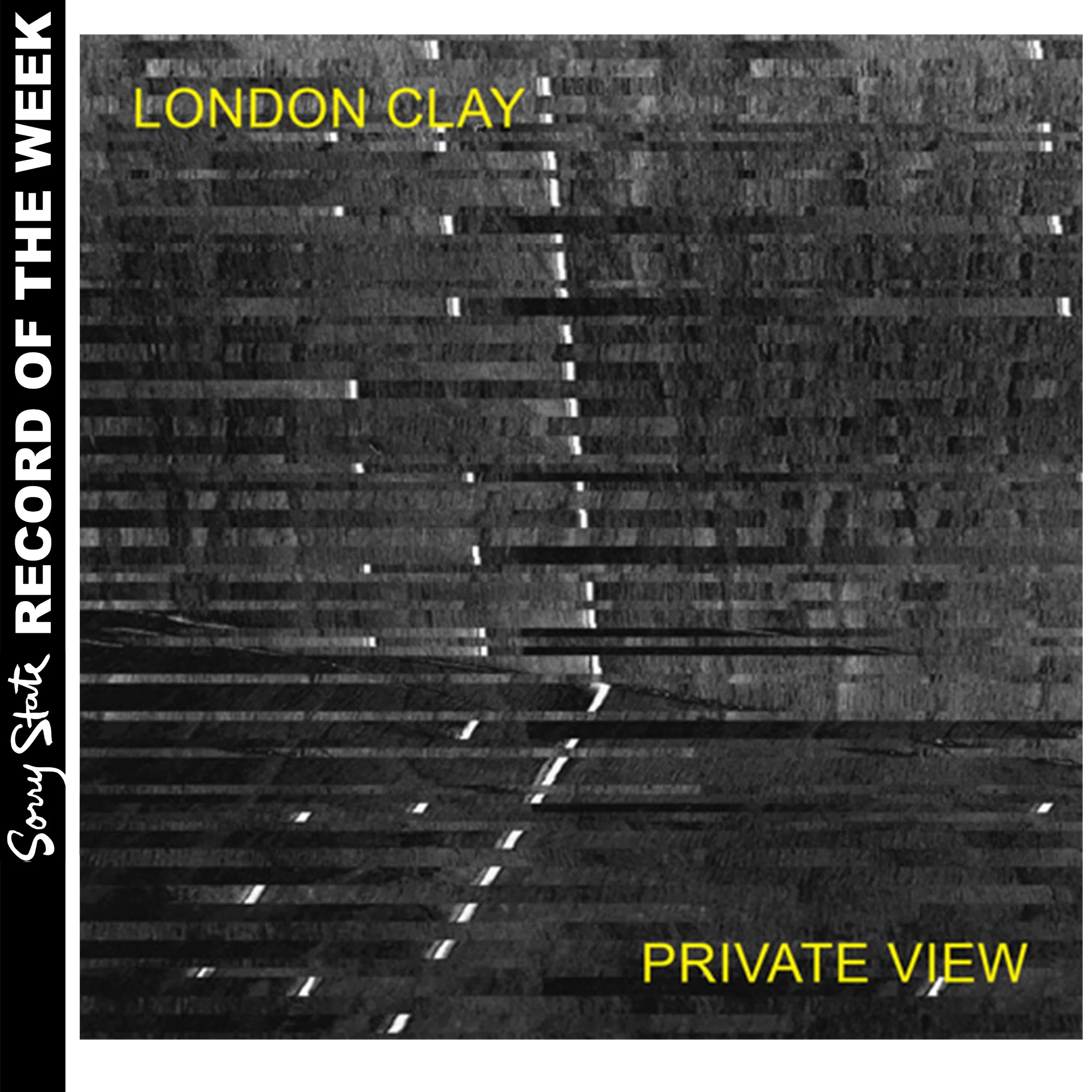
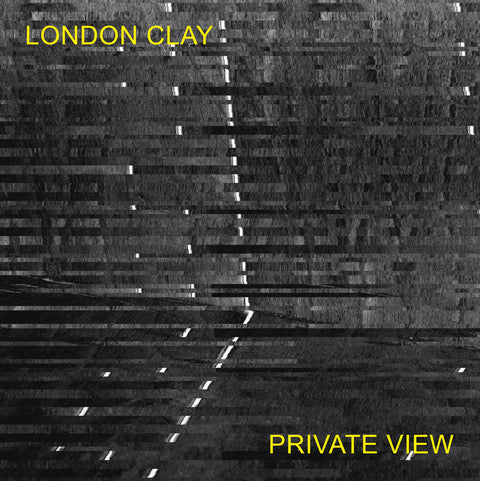
London Clay: Private View 12”
London Clay: Private View 12”
There’s undeniably a certain kind of environment conjured up by the music of London Clay: drab municipal housing schemes; concrete walkways; a parade of shops in a post-war suburb; an underpass running underneath a dual carriageway; decaying social housing stock; the shadows of new build blocks for young professionals falling across the ever changing landscape. When they sing “tarmac shimmers, no future plans” you can feel this sense of place pressing in on the songs, shaping the melodies like they’re harmonising with the wind blowing through scaffolding sheets, the rhythms reflecting the sound of jackhammers and wrecking balls.
This description perhaps makes their music sound somewhat uninviting, and whilst it is suffused with a certain amount of urban claustrophobia and late night paranoia, there’s also a lightness of touch that illuminates the dark corners - the gentle tone of a human voice and memorable repeating keyboard motifs offsetting the industrial chug. And whilst you can locate this music on a broad spectrum of post-punk (that most malleable and co-opted of genre terms), particularly the sounds of early 1980s Sheffield, there’s a more varied sonic palette at play than that might suggest. At various points as you listen to this record you can hear: the looped sound of a dot matrix printer as percussive texture; a delay-blasted guitar weaving in and out of arpeggiated synth bursts; a descending piano line that sounds like it’s haunting the corridors of a deserted school hall; a cluster of distorted loops building to a crescendo that wouldn’t sound out of place next to mid-period Autechre; the jacking drum machine intro to one track almost verging on acid house; the terms and conditions of a marketing offer repeated to the point of hypnotic trance.
Despite any broad and subjective comparisons, this record is of course its own thing, an end result that is certainly more than the sum of its parts, the mood that is established unique to this band and these songs, the listener drawn inexorably into their world. Tracks rise and fall like the continuous destruction and reconstruction of the capital skyline, a mental map to locate the essence of London Clay.
– Selpic Sid
Our take:
La Vida Es Un Mus released this full-length debut from London Clay late in 2025, but it seemed to fly under many people’s radars. Which makes sense, I suppose, because Private View is a wallflower of a record. While most records burst into the room screaming “LOOK HOW COOL I AM! LIKE ME!,” Private View sulks in the corner intriguingly, reading a book that’s too smart for you, daring you to engage. I contend that Private View is a beautiful, fascinating record, but it reveals itself slowly. The notes I made while listening to Private View are full of words like “smudged,” “smeared,” and “blurred,” and when you compare London Clay with the crispness of groups like Modem or Fatamorgana (ostensibly similar bands, in that they feature feminine vocals and primarily electronic instruments), the difference is striking. With those artists, the beats are insistent and the melodies are crystalline, so clear it’s like they beamed them straight into your brain. But there’s something tantalizing about the way London Clay buries their melodies in distortion and delay and the way the singer murmurs into the microphone like she’s afraid of being overheard. The object of my desire—that glorious pop nugget that lies just below the surface of these songs—drifts in and out of focus, but lives mostly in a space that’s just out of reach. On “Faraday” it’s right there, while “Clifton Rise” teases you for nearly five minutes before it delivers its blissed-out, shoegaze-y crescendo. And then there’s “The Obelisk,” a patience-testing eight-minute track (song? piece of musique concrète?) whose rhythm track loops a screeching 70s/80s-era dot matrix printer… the song makes me feel like I’m trapped in an office that doubles as an outer circle of hell. The handful of similar records I can think of—the Fall’s Dragnet, SPK’s early singles, the new Puppet Wipes album from last year—also have their difficult moments, and those moments are important. By pushing you away with “The Obelisk,” “Clifton Rise” shines that much brighter. The packaging extends this aesthetic beautifully, particularly the half-size zine that accompanies the vinyl. Page after page of mostly text-less collages grounded in the Crass / Poison Girls aesthetic (and similarly beautiful), but with a Situationist-like inscrutability. So, if you’re the kind of uncomplicated person who can get out of your own head and just enjoy a dumb pop tune, then maybe Private Viewisn’t for you. But if you’re a worrier, if you like arty films, and if your most valued experiences with art tend to start with disorientation, then maybe it’s worth making space in your life for London Clay.
Product Information
Product Information
Shipping & Returns
Shipping & Returns
Description
There’s undeniably a certain kind of environment conjured up by the music of London Clay: drab municipal housing schemes; concrete walkways; a parade of shops in a post-war suburb; an underpass running underneath a dual carriageway; decaying social housing stock; the shadows of new build blocks for young professionals falling across the ever changing landscape. When they sing “tarmac shimmers, no future plans” you can feel this sense of place pressing in on the songs, shaping the melodies like they’re harmonising with the wind blowing through scaffolding sheets, the rhythms reflecting the sound of jackhammers and wrecking balls.
This description perhaps makes their music sound somewhat uninviting, and whilst it is suffused with a certain amount of urban claustrophobia and late night paranoia, there’s also a lightness of touch that illuminates the dark corners - the gentle tone of a human voice and memorable repeating keyboard motifs offsetting the industrial chug. And whilst you can locate this music on a broad spectrum of post-punk (that most malleable and co-opted of genre terms), particularly the sounds of early 1980s Sheffield, there’s a more varied sonic palette at play than that might suggest. At various points as you listen to this record you can hear: the looped sound of a dot matrix printer as percussive texture; a delay-blasted guitar weaving in and out of arpeggiated synth bursts; a descending piano line that sounds like it’s haunting the corridors of a deserted school hall; a cluster of distorted loops building to a crescendo that wouldn’t sound out of place next to mid-period Autechre; the jacking drum machine intro to one track almost verging on acid house; the terms and conditions of a marketing offer repeated to the point of hypnotic trance.
Despite any broad and subjective comparisons, this record is of course its own thing, an end result that is certainly more than the sum of its parts, the mood that is established unique to this band and these songs, the listener drawn inexorably into their world. Tracks rise and fall like the continuous destruction and reconstruction of the capital skyline, a mental map to locate the essence of London Clay.
– Selpic Sid
Our take:
La Vida Es Un Mus released this full-length debut from London Clay late in 2025, but it seemed to fly under many people’s radars. Which makes sense, I suppose, because Private View is a wallflower of a record. While most records burst into the room screaming “LOOK HOW COOL I AM! LIKE ME!,” Private View sulks in the corner intriguingly, reading a book that’s too smart for you, daring you to engage. I contend that Private View is a beautiful, fascinating record, but it reveals itself slowly. The notes I made while listening to Private View are full of words like “smudged,” “smeared,” and “blurred,” and when you compare London Clay with the crispness of groups like Modem or Fatamorgana (ostensibly similar bands, in that they feature feminine vocals and primarily electronic instruments), the difference is striking. With those artists, the beats are insistent and the melodies are crystalline, so clear it’s like they beamed them straight into your brain. But there’s something tantalizing about the way London Clay buries their melodies in distortion and delay and the way the singer murmurs into the microphone like she’s afraid of being overheard. The object of my desire—that glorious pop nugget that lies just below the surface of these songs—drifts in and out of focus, but lives mostly in a space that’s just out of reach. On “Faraday” it’s right there, while “Clifton Rise” teases you for nearly five minutes before it delivers its blissed-out, shoegaze-y crescendo. And then there’s “The Obelisk,” a patience-testing eight-minute track (song? piece of musique concrète?) whose rhythm track loops a screeching 70s/80s-era dot matrix printer… the song makes me feel like I’m trapped in an office that doubles as an outer circle of hell. The handful of similar records I can think of—the Fall’s Dragnet, SPK’s early singles, the new Puppet Wipes album from last year—also have their difficult moments, and those moments are important. By pushing you away with “The Obelisk,” “Clifton Rise” shines that much brighter. The packaging extends this aesthetic beautifully, particularly the half-size zine that accompanies the vinyl. Page after page of mostly text-less collages grounded in the Crass / Poison Girls aesthetic (and similarly beautiful), but with a Situationist-like inscrutability. So, if you’re the kind of uncomplicated person who can get out of your own head and just enjoy a dumb pop tune, then maybe Private Viewisn’t for you. But if you’re a worrier, if you like arty films, and if your most valued experiences with art tend to start with disorientation, then maybe it’s worth making space in your life for London Clay.