King Tubby & The Aggrovators: Dubbing in The Backyard 12"
In May 1982, a British film crew pulled up outside King Tubby’s studio in Kingston. They were greeted by resident engineer Prince Jammy and producer Bunny ‘Striker’ Lee, who had brought along some of their top artists to perform for the cameras. The crew were halfway through a busy two weeks shooting the documentary series ‘Deep Roots Music’ for Channel 4 television.
Director Howard Johnson: “King Tubby’s was different from the other Jamaican studios because it was just like a hole in the wall kind of thing, with one microphone. I didn’t know Bunny Lee when he first came to see me at my hotel, but he had a kind of energy to him that I liked, so I said OK, let’s film. So Bunny arranged for us to shoot round at Tubby’s, with Prince Jammy as the engineer there. You had to have a great engineer to make the shooting run quickly and smoothly.”
The cameraman was Roger Deakins, who has since found fame in Hollywood as the director of photography for directors like the Coen brothers and Martin Scorsese.
Howard Johnson: “Roger Deakins worked out that if we had a moving camera we could capture what was going on. There were a lot of people in the studio dancing, and Bunny’s kid and a couple of women. Having an audience always helps everyone perform. So Bunny was a kind of circus master – he’s dancing away and being jolly, but that’s his thing. He was always getting the atmosphere and the ambience to make it look terrific, and that’s what he’s good at… that’s why he’s a producer. The lighting was very minimal, the singers lined up and we said let’s roll.”
The singers included Johnny Clarke, Jackie Edwards, Delroy Wilson, and Prince Jammy’s new protégé Wayne Smith, still three years away from his breakthrough hit ‘Under Me Sleng Teng’. The music Bunny was now recording had changed from the ‘steppas’ style which had ruled the dancehalls at the end of the ‘70s. The Roots Radics band now dominated the recording scene of the early 1980s, with a stripped down and minimal sound that emphasized the one beat on the kick drum. Bunny, however, refused to use the Radics, having run bass player Errol ‘Flabba’ Holt out of their only session together because “the man couldn’t stay in tune”. Bunny still worked with Sly and Robbie on occasion, but the backing tracks on ‘Dubbing In The Backyard’ were mostly laid by members of the High Times Band, not credited on the original sleeve.
Bunny Lee: “Me use Benbow on drums, him full name Basil Creary, and Chris Meredith on bass, a lickle youth that Chinna (Earl ‘Chinna’ Smith) bring over from England. Chinna play on most of them, and on drums some was Benbow and some was Santa (Carlton ‘Santa’ Davis). The style was different, slower, with more splash in the drums. ‘Dubbing In The Backyard’ was another Jammy’s mix. Him could just make everything sound tight and heavy. It great man!”
After the film shows each of the singers performing, it is the turn of Prince Jammy to shine. Jammy had mixed the ‘Dubbing In The Backyard’ LP at King Tubby’s a few weeks earlier in exactly the way that was now being filmed. We see him mixing a brutal dub version of Bunny’s Sly and Robbie recut of ‘None Shall Escape The Judgement’ by Johnny Clarke. In the studio, Bunny leads the dancing, breaking off to perform the splits a couple of times. Then the apprentice engineer Pug lights up a chalice, and the studio is soon obscured by thick smoke.
This is really the only extensive footage of King Tubby’s studio, other than a brief scene in a BBC documentary about Musical Youth, and ten seconds of silent Japanese footage of King Tubby himself standing in his workshop. In 1982, the studio was reaching the end of its golden era as the mixing house of choice for Jamaica’s heaviest music. Tubby had retired from mixing, Scientist had moved on to Channel One studios, and Jammy was on his way out as well.
Bunny Lee: “This was just before Jammys start to set up him own studio. What really happen is that Jammys was cutting dubplates in secret for sounds like Emperor Faith and Ray Symbolic without telling Tubbys. Well Tubbys finds out now and just change the locks on the studio to keep Jammys out. Then Professor come in as the main engineer, but soon the squawky (high pass filter) on the board break down, and it lose that sound.”
‘Dubbing In The Backyard’ showcases dubs to three tracks from Delroy Wilson’s ‘Go Away Dream’ LP, along with dubs to tunes by Cornell Campbell, Jackie Edwards and Johnny Clarke. Both albums were issued in the UK through Starlight Music in Harlesden.
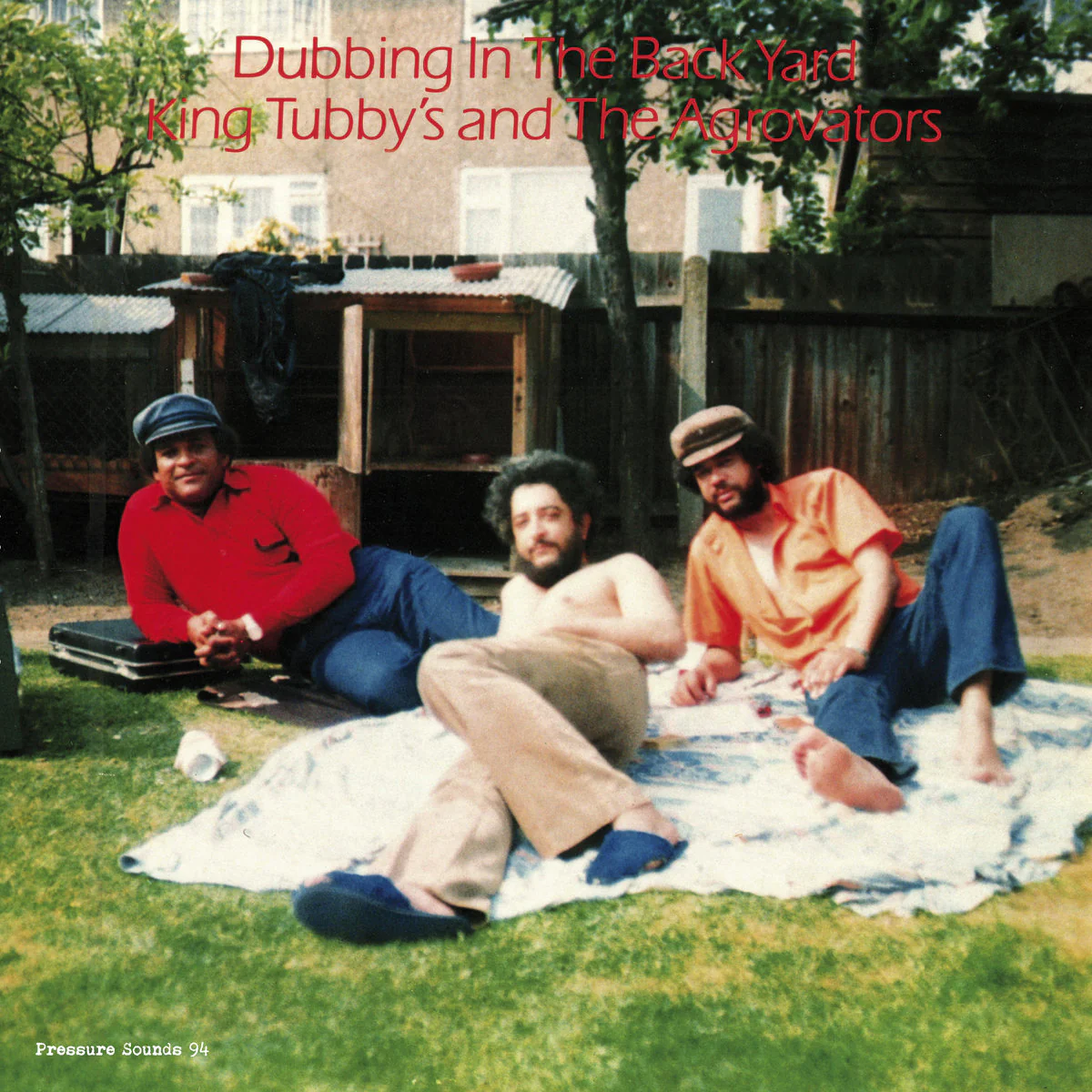
Bunny Lee: “For ‘Dubbing In The Backyard’, that picture is me with my briefcase, and Desmond Bryan who run Starlight, and his brother Benup. It was taken in Wembley in Desmond’s yard. We spend a lot of time in England always cos that is where the business is.”
The album stands up very well today, with its crisp, punchy backing tracks, soulful vocals and detailed mixing. Less texturally rich than earlier, classic Aggrovators rhythms, the sound is sometimes brutally heavy and insistent, and a perfect showcase for some of Prince Jammy’s last mixes from King Tubby’s Studio.
- Label: Pressure Sounds
- Format Type: 12"
- Genre: reggae
Product Information
Product Information
Shipping & Returns
Shipping & Returns
King Tubby & The Aggrovators: Dubbing in The Backyard 12"
King Tubby & The Aggrovators: Dubbing in The Backyard 12"
In May 1982, a British film crew pulled up outside King Tubby’s studio in Kingston. They were greeted by resident engineer Prince Jammy and producer Bunny ‘Striker’ Lee, who had brought along some of their top artists to perform for the cameras. The crew were halfway through a busy two weeks shooting the documentary series ‘Deep Roots Music’ for Channel 4 television.
Director Howard Johnson: “King Tubby’s was different from the other Jamaican studios because it was just like a hole in the wall kind of thing, with one microphone. I didn’t know Bunny Lee when he first came to see me at my hotel, but he had a kind of energy to him that I liked, so I said OK, let’s film. So Bunny arranged for us to shoot round at Tubby’s, with Prince Jammy as the engineer there. You had to have a great engineer to make the shooting run quickly and smoothly.”
The cameraman was Roger Deakins, who has since found fame in Hollywood as the director of photography for directors like the Coen brothers and Martin Scorsese.
Howard Johnson: “Roger Deakins worked out that if we had a moving camera we could capture what was going on. There were a lot of people in the studio dancing, and Bunny’s kid and a couple of women. Having an audience always helps everyone perform. So Bunny was a kind of circus master – he’s dancing away and being jolly, but that’s his thing. He was always getting the atmosphere and the ambience to make it look terrific, and that’s what he’s good at… that’s why he’s a producer. The lighting was very minimal, the singers lined up and we said let’s roll.”
The singers included Johnny Clarke, Jackie Edwards, Delroy Wilson, and Prince Jammy’s new protégé Wayne Smith, still three years away from his breakthrough hit ‘Under Me Sleng Teng’. The music Bunny was now recording had changed from the ‘steppas’ style which had ruled the dancehalls at the end of the ‘70s. The Roots Radics band now dominated the recording scene of the early 1980s, with a stripped down and minimal sound that emphasized the one beat on the kick drum. Bunny, however, refused to use the Radics, having run bass player Errol ‘Flabba’ Holt out of their only session together because “the man couldn’t stay in tune”. Bunny still worked with Sly and Robbie on occasion, but the backing tracks on ‘Dubbing In The Backyard’ were mostly laid by members of the High Times Band, not credited on the original sleeve.
Bunny Lee: “Me use Benbow on drums, him full name Basil Creary, and Chris Meredith on bass, a lickle youth that Chinna (Earl ‘Chinna’ Smith) bring over from England. Chinna play on most of them, and on drums some was Benbow and some was Santa (Carlton ‘Santa’ Davis). The style was different, slower, with more splash in the drums. ‘Dubbing In The Backyard’ was another Jammy’s mix. Him could just make everything sound tight and heavy. It great man!”
After the film shows each of the singers performing, it is the turn of Prince Jammy to shine. Jammy had mixed the ‘Dubbing In The Backyard’ LP at King Tubby’s a few weeks earlier in exactly the way that was now being filmed. We see him mixing a brutal dub version of Bunny’s Sly and Robbie recut of ‘None Shall Escape The Judgement’ by Johnny Clarke. In the studio, Bunny leads the dancing, breaking off to perform the splits a couple of times. Then the apprentice engineer Pug lights up a chalice, and the studio is soon obscured by thick smoke.
This is really the only extensive footage of King Tubby’s studio, other than a brief scene in a BBC documentary about Musical Youth, and ten seconds of silent Japanese footage of King Tubby himself standing in his workshop. In 1982, the studio was reaching the end of its golden era as the mixing house of choice for Jamaica’s heaviest music. Tubby had retired from mixing, Scientist had moved on to Channel One studios, and Jammy was on his way out as well.
Bunny Lee: “This was just before Jammys start to set up him own studio. What really happen is that Jammys was cutting dubplates in secret for sounds like Emperor Faith and Ray Symbolic without telling Tubbys. Well Tubbys finds out now and just change the locks on the studio to keep Jammys out. Then Professor come in as the main engineer, but soon the squawky (high pass filter) on the board break down, and it lose that sound.”
‘Dubbing In The Backyard’ showcases dubs to three tracks from Delroy Wilson’s ‘Go Away Dream’ LP, along with dubs to tunes by Cornell Campbell, Jackie Edwards and Johnny Clarke. Both albums were issued in the UK through Starlight Music in Harlesden.
Bunny Lee: “For ‘Dubbing In The Backyard’, that picture is me with my briefcase, and Desmond Bryan who run Starlight, and his brother Benup. It was taken in Wembley in Desmond’s yard. We spend a lot of time in England always cos that is where the business is.”
The album stands up very well today, with its crisp, punchy backing tracks, soulful vocals and detailed mixing. Less texturally rich than earlier, classic Aggrovators rhythms, the sound is sometimes brutally heavy and insistent, and a perfect showcase for some of Prince Jammy’s last mixes from King Tubby’s Studio.
- Label: Pressure Sounds
- Format Type: 12"
- Genre: reggae
Product Information
Product Information
Shipping & Returns
Shipping & Returns
Description
In May 1982, a British film crew pulled up outside King Tubby’s studio in Kingston. They were greeted by resident engineer Prince Jammy and producer Bunny ‘Striker’ Lee, who had brought along some of their top artists to perform for the cameras. The crew were halfway through a busy two weeks shooting the documentary series ‘Deep Roots Music’ for Channel 4 television.
Director Howard Johnson: “King Tubby’s was different from the other Jamaican studios because it was just like a hole in the wall kind of thing, with one microphone. I didn’t know Bunny Lee when he first came to see me at my hotel, but he had a kind of energy to him that I liked, so I said OK, let’s film. So Bunny arranged for us to shoot round at Tubby’s, with Prince Jammy as the engineer there. You had to have a great engineer to make the shooting run quickly and smoothly.”
The cameraman was Roger Deakins, who has since found fame in Hollywood as the director of photography for directors like the Coen brothers and Martin Scorsese.
Howard Johnson: “Roger Deakins worked out that if we had a moving camera we could capture what was going on. There were a lot of people in the studio dancing, and Bunny’s kid and a couple of women. Having an audience always helps everyone perform. So Bunny was a kind of circus master – he’s dancing away and being jolly, but that’s his thing. He was always getting the atmosphere and the ambience to make it look terrific, and that’s what he’s good at… that’s why he’s a producer. The lighting was very minimal, the singers lined up and we said let’s roll.”
The singers included Johnny Clarke, Jackie Edwards, Delroy Wilson, and Prince Jammy’s new protégé Wayne Smith, still three years away from his breakthrough hit ‘Under Me Sleng Teng’. The music Bunny was now recording had changed from the ‘steppas’ style which had ruled the dancehalls at the end of the ‘70s. The Roots Radics band now dominated the recording scene of the early 1980s, with a stripped down and minimal sound that emphasized the one beat on the kick drum. Bunny, however, refused to use the Radics, having run bass player Errol ‘Flabba’ Holt out of their only session together because “the man couldn’t stay in tune”. Bunny still worked with Sly and Robbie on occasion, but the backing tracks on ‘Dubbing In The Backyard’ were mostly laid by members of the High Times Band, not credited on the original sleeve.
Bunny Lee: “Me use Benbow on drums, him full name Basil Creary, and Chris Meredith on bass, a lickle youth that Chinna (Earl ‘Chinna’ Smith) bring over from England. Chinna play on most of them, and on drums some was Benbow and some was Santa (Carlton ‘Santa’ Davis). The style was different, slower, with more splash in the drums. ‘Dubbing In The Backyard’ was another Jammy’s mix. Him could just make everything sound tight and heavy. It great man!”
After the film shows each of the singers performing, it is the turn of Prince Jammy to shine. Jammy had mixed the ‘Dubbing In The Backyard’ LP at King Tubby’s a few weeks earlier in exactly the way that was now being filmed. We see him mixing a brutal dub version of Bunny’s Sly and Robbie recut of ‘None Shall Escape The Judgement’ by Johnny Clarke. In the studio, Bunny leads the dancing, breaking off to perform the splits a couple of times. Then the apprentice engineer Pug lights up a chalice, and the studio is soon obscured by thick smoke.
This is really the only extensive footage of King Tubby’s studio, other than a brief scene in a BBC documentary about Musical Youth, and ten seconds of silent Japanese footage of King Tubby himself standing in his workshop. In 1982, the studio was reaching the end of its golden era as the mixing house of choice for Jamaica’s heaviest music. Tubby had retired from mixing, Scientist had moved on to Channel One studios, and Jammy was on his way out as well.
Bunny Lee: “This was just before Jammys start to set up him own studio. What really happen is that Jammys was cutting dubplates in secret for sounds like Emperor Faith and Ray Symbolic without telling Tubbys. Well Tubbys finds out now and just change the locks on the studio to keep Jammys out. Then Professor come in as the main engineer, but soon the squawky (high pass filter) on the board break down, and it lose that sound.”
‘Dubbing In The Backyard’ showcases dubs to three tracks from Delroy Wilson’s ‘Go Away Dream’ LP, along with dubs to tunes by Cornell Campbell, Jackie Edwards and Johnny Clarke. Both albums were issued in the UK through Starlight Music in Harlesden.
Bunny Lee: “For ‘Dubbing In The Backyard’, that picture is me with my briefcase, and Desmond Bryan who run Starlight, and his brother Benup. It was taken in Wembley in Desmond’s yard. We spend a lot of time in England always cos that is where the business is.”
The album stands up very well today, with its crisp, punchy backing tracks, soulful vocals and detailed mixing. Less texturally rich than earlier, classic Aggrovators rhythms, the sound is sometimes brutally heavy and insistent, and a perfect showcase for some of Prince Jammy’s last mixes from King Tubby’s Studio.
- Label: Pressure Sounds
- Format Type: 12"
- Genre: reggae