🎉 Up to 70% Off Selected ItemsShop Sale
Bright Eyes: I'm Wide Awake, It's Morning 12"
“It’s a meaningful way to connect with the past that doesn’t feel totally nostalgic and self-indulgent,” says Conor Oberst of the forthcoming Bright Eyes reissue project. “We are taking these songs and making them interesting to us all over again. I like that. I like a challenge. I like to be forced to do something that’s slightly hard, just to see if we can.”
“Just to see if we can” could be the unofficial motto of Bright Eyes, the band Oberst founded as a teenager and plays in with two of his oldest friends, multi-instrumentalists Mike Mogis and Nate Walcott. “We’ve never made the same record twice,” the singer says. “I’m proud of that.” From warm folk-rock to austere electro, plaintive, earnest ballads to glacially cool guitar noise, Bright Eyes has tried on pretty much every sound that’s ever inspired them, just to see if they could. Along the way they’ve collaborated with many of their influences, heroes, and peers, from Gillian Welch and Emmylou Harris to Jenny Lewis, Nick Zinner and Britt Daniel. And they’ve seen their songs covered by many more, including Lorde, The Killers, and Mac Miller.
For a band that’s often been perceived as an outlier – the ingenious but quixotic group fronted by that wunderkind singer-songwriter with the floppy hair and bedroom eyes - the depth, breadth, and impact of the Bright Eyes canon is remarkable. And that’s what really strikes you when you sit down to fully take in the nine Bright Eyes albums that will be reissued, in chronological order, in groups of three, beginning this spring. Over the last two-plus decades, as Bright Eyes has released one after another time capsule LP’s –urgent dispatches from transcendent, fleeting eras of our collective lives – they’ve also simultaneously been assembling a robust, mature, narratively cohesive discography. “I’ve written a looooot of songs,” Oberst says, laughing. “And by no means are they all good, but the fact that we can cull through these records and find ones that I’m not ashamed to sing years later makes me feel pretty happy.”
It’s the desire to celebrate that sonic bounty that first got Oberst and the band excited about the idea of comprehensive reissues. But this wouldn’t be a Bright Eyes project if a moment devoted to appreciating the past weren’t turned into an opportunity to connect with the future. That’s where the nine companion EPs come in. Or as Oberst puts it, “the supplemental reading” for the primary reissues: One six-track EP per reissued album, each featuring five reworked songs from that album. “My thing was they had to sound different from the originals, we had to mess with them in a substantial way.” Plus one cover that felt “of the era” in which that particular albums was made – a song that meant something to the band at the time. To help the EPs come alive in the fullest way, Bright Eyes called in lots of old friends, like Bridgers, M. Ward, and Welch and Rawlings, as well as new ones like Katie Crutchfield of Waxahatchee.
It was the band’s way of reframing, rediscovering, and renewing the past. It was also a hilarious amount of work. “I thought it was a cool concept,” Oberst says. “Then I realized its nine records, six songs a piece, so that’s like 54 different songs you have to record!” He laughs. But if there’s a mantra more central to the Bright Eyes ethos as trying something new just to see if you can get away with it, it’s signing up for way more than you can handle just to see if you can make it work. “We always bite off more than we can chew,” Oberst summarizes. “It keeps things interesting.”
I’m Wide Awake, It’s Morning (2005)
“The first three are innocent in a way, because we didn’t have an audience when we were making them,” Oberst says. “But from Lifted on, I was definitely aware of an audience. Lifted was well-received right away, and then everything happened with Wide Awake and Digital Ash.” Those two albums came out simultaneously. And their lead singles – “Take It Easy (Love Nothing),” from the austere, remote Digital Ash, and “Lua,” from the warm, folky Wide Awake - debuted in the top two slots on the Billboard Hot 100. “First Day of My Life,” also from Wide Awake, would later be voted the Number One love song of all time by NPR Music’s reader’s poll.
Bright Eyes had officially broken through. It was a heady, exciting time, but also fraught and tense, both because of the band’s careening new fame, and because of the state of the world. When Bright Eyes made their Tonight Show debut in 2006, they chose to perform none of their shiny new hits, instead delivering a searing, harrowing rendition of their caustic anti-Bush anthem, “When The President Talks To God.”
These days, Oberst is still amusing himself by messing with the extremes Bright Eyes baked into this era’s releases, extremes that reflected the polar, with-us-or-against-us, fractious feel of the times. The reworked Digital Ash tracks, originally so clean and elegant, are, on the companion EP, full of “harmonica and mandolins – folky vibes,” Oberst says. While the analogue sweetness of the Wide Awake songs have been put through a detached nihilism filter.
“Just to see if we can” could be the unofficial motto of Bright Eyes, the band Oberst founded as a teenager and plays in with two of his oldest friends, multi-instrumentalists Mike Mogis and Nate Walcott. “We’ve never made the same record twice,” the singer says. “I’m proud of that.” From warm folk-rock to austere electro, plaintive, earnest ballads to glacially cool guitar noise, Bright Eyes has tried on pretty much every sound that’s ever inspired them, just to see if they could. Along the way they’ve collaborated with many of their influences, heroes, and peers, from Gillian Welch and Emmylou Harris to Jenny Lewis, Nick Zinner and Britt Daniel. And they’ve seen their songs covered by many more, including Lorde, The Killers, and Mac Miller.
For a band that’s often been perceived as an outlier – the ingenious but quixotic group fronted by that wunderkind singer-songwriter with the floppy hair and bedroom eyes - the depth, breadth, and impact of the Bright Eyes canon is remarkable. And that’s what really strikes you when you sit down to fully take in the nine Bright Eyes albums that will be reissued, in chronological order, in groups of three, beginning this spring. Over the last two-plus decades, as Bright Eyes has released one after another time capsule LP’s –urgent dispatches from transcendent, fleeting eras of our collective lives – they’ve also simultaneously been assembling a robust, mature, narratively cohesive discography. “I’ve written a looooot of songs,” Oberst says, laughing. “And by no means are they all good, but the fact that we can cull through these records and find ones that I’m not ashamed to sing years later makes me feel pretty happy.”
It’s the desire to celebrate that sonic bounty that first got Oberst and the band excited about the idea of comprehensive reissues. But this wouldn’t be a Bright Eyes project if a moment devoted to appreciating the past weren’t turned into an opportunity to connect with the future. That’s where the nine companion EPs come in. Or as Oberst puts it, “the supplemental reading” for the primary reissues: One six-track EP per reissued album, each featuring five reworked songs from that album. “My thing was they had to sound different from the originals, we had to mess with them in a substantial way.” Plus one cover that felt “of the era” in which that particular albums was made – a song that meant something to the band at the time. To help the EPs come alive in the fullest way, Bright Eyes called in lots of old friends, like Bridgers, M. Ward, and Welch and Rawlings, as well as new ones like Katie Crutchfield of Waxahatchee.
It was the band’s way of reframing, rediscovering, and renewing the past. It was also a hilarious amount of work. “I thought it was a cool concept,” Oberst says. “Then I realized its nine records, six songs a piece, so that’s like 54 different songs you have to record!” He laughs. But if there’s a mantra more central to the Bright Eyes ethos as trying something new just to see if you can get away with it, it’s signing up for way more than you can handle just to see if you can make it work. “We always bite off more than we can chew,” Oberst summarizes. “It keeps things interesting.”
I’m Wide Awake, It’s Morning (2005)
“The first three are innocent in a way, because we didn’t have an audience when we were making them,” Oberst says. “But from Lifted on, I was definitely aware of an audience. Lifted was well-received right away, and then everything happened with Wide Awake and Digital Ash.” Those two albums came out simultaneously. And their lead singles – “Take It Easy (Love Nothing),” from the austere, remote Digital Ash, and “Lua,” from the warm, folky Wide Awake - debuted in the top two slots on the Billboard Hot 100. “First Day of My Life,” also from Wide Awake, would later be voted the Number One love song of all time by NPR Music’s reader’s poll.
Bright Eyes had officially broken through. It was a heady, exciting time, but also fraught and tense, both because of the band’s careening new fame, and because of the state of the world. When Bright Eyes made their Tonight Show debut in 2006, they chose to perform none of their shiny new hits, instead delivering a searing, harrowing rendition of their caustic anti-Bush anthem, “When The President Talks To God.”
These days, Oberst is still amusing himself by messing with the extremes Bright Eyes baked into this era’s releases, extremes that reflected the polar, with-us-or-against-us, fractious feel of the times. The reworked Digital Ash tracks, originally so clean and elegant, are, on the companion EP, full of “harmonica and mandolins – folky vibes,” Oberst says. While the analogue sweetness of the Wide Awake songs have been put through a detached nihilism filter.
Product Information
Product Information
Shipping & Returns
Shipping & Returns
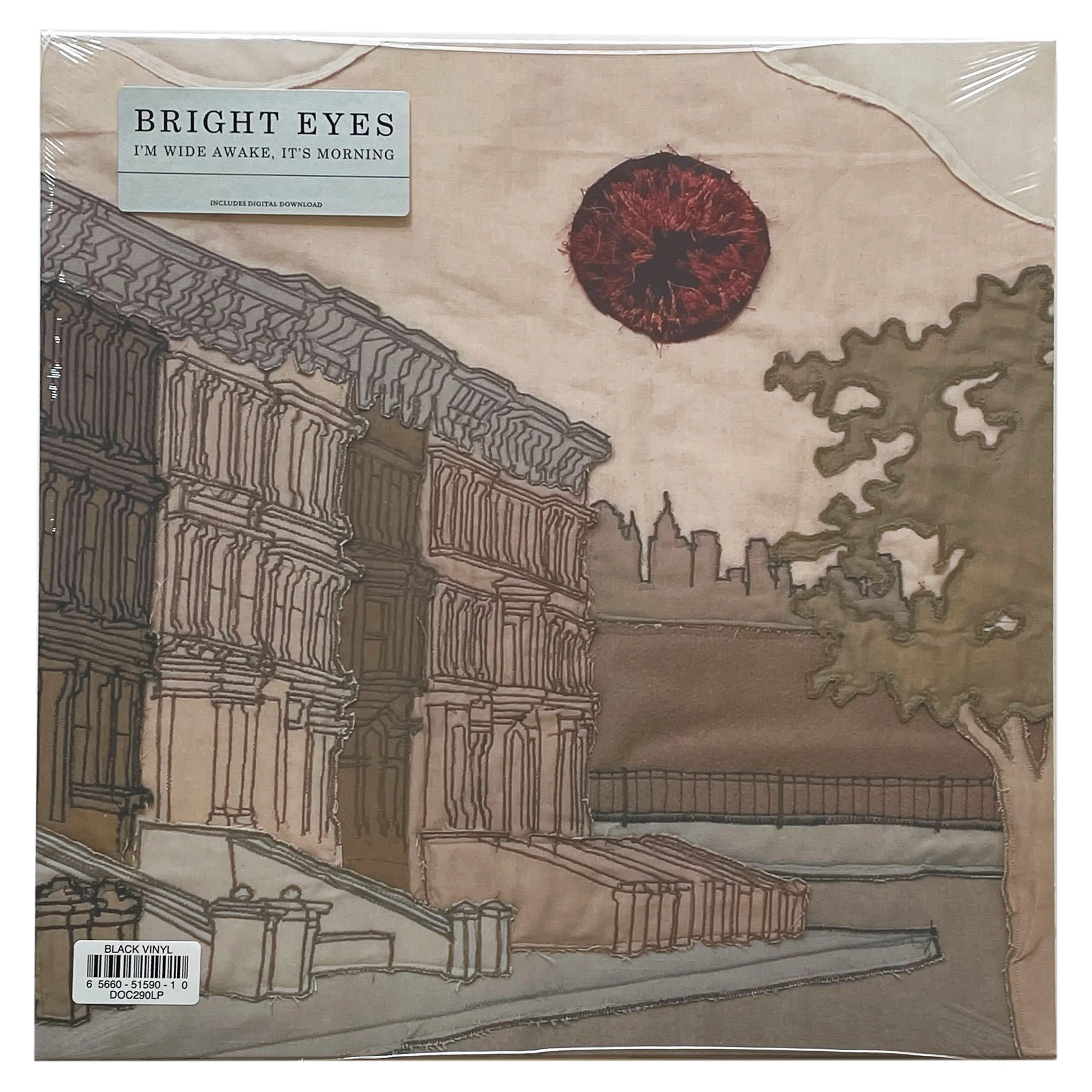
Bright Eyes: I'm Wide Awake, It's Morning 12"
Bright Eyes: I'm Wide Awake, It's Morning 12"
“It’s a meaningful way to connect with the past that doesn’t feel totally nostalgic and self-indulgent,” says Conor Oberst of the forthcoming Bright Eyes reissue project. “We are taking these songs and making them interesting to us all over again. I like that. I like a challenge. I like to be forced to do something that’s slightly hard, just to see if we can.”
“Just to see if we can” could be the unofficial motto of Bright Eyes, the band Oberst founded as a teenager and plays in with two of his oldest friends, multi-instrumentalists Mike Mogis and Nate Walcott. “We’ve never made the same record twice,” the singer says. “I’m proud of that.” From warm folk-rock to austere electro, plaintive, earnest ballads to glacially cool guitar noise, Bright Eyes has tried on pretty much every sound that’s ever inspired them, just to see if they could. Along the way they’ve collaborated with many of their influences, heroes, and peers, from Gillian Welch and Emmylou Harris to Jenny Lewis, Nick Zinner and Britt Daniel. And they’ve seen their songs covered by many more, including Lorde, The Killers, and Mac Miller.
For a band that’s often been perceived as an outlier – the ingenious but quixotic group fronted by that wunderkind singer-songwriter with the floppy hair and bedroom eyes - the depth, breadth, and impact of the Bright Eyes canon is remarkable. And that’s what really strikes you when you sit down to fully take in the nine Bright Eyes albums that will be reissued, in chronological order, in groups of three, beginning this spring. Over the last two-plus decades, as Bright Eyes has released one after another time capsule LP’s –urgent dispatches from transcendent, fleeting eras of our collective lives – they’ve also simultaneously been assembling a robust, mature, narratively cohesive discography. “I’ve written a looooot of songs,” Oberst says, laughing. “And by no means are they all good, but the fact that we can cull through these records and find ones that I’m not ashamed to sing years later makes me feel pretty happy.”
It’s the desire to celebrate that sonic bounty that first got Oberst and the band excited about the idea of comprehensive reissues. But this wouldn’t be a Bright Eyes project if a moment devoted to appreciating the past weren’t turned into an opportunity to connect with the future. That’s where the nine companion EPs come in. Or as Oberst puts it, “the supplemental reading” for the primary reissues: One six-track EP per reissued album, each featuring five reworked songs from that album. “My thing was they had to sound different from the originals, we had to mess with them in a substantial way.” Plus one cover that felt “of the era” in which that particular albums was made – a song that meant something to the band at the time. To help the EPs come alive in the fullest way, Bright Eyes called in lots of old friends, like Bridgers, M. Ward, and Welch and Rawlings, as well as new ones like Katie Crutchfield of Waxahatchee.
It was the band’s way of reframing, rediscovering, and renewing the past. It was also a hilarious amount of work. “I thought it was a cool concept,” Oberst says. “Then I realized its nine records, six songs a piece, so that’s like 54 different songs you have to record!” He laughs. But if there’s a mantra more central to the Bright Eyes ethos as trying something new just to see if you can get away with it, it’s signing up for way more than you can handle just to see if you can make it work. “We always bite off more than we can chew,” Oberst summarizes. “It keeps things interesting.”
I’m Wide Awake, It’s Morning (2005)
“The first three are innocent in a way, because we didn’t have an audience when we were making them,” Oberst says. “But from Lifted on, I was definitely aware of an audience. Lifted was well-received right away, and then everything happened with Wide Awake and Digital Ash.” Those two albums came out simultaneously. And their lead singles – “Take It Easy (Love Nothing),” from the austere, remote Digital Ash, and “Lua,” from the warm, folky Wide Awake - debuted in the top two slots on the Billboard Hot 100. “First Day of My Life,” also from Wide Awake, would later be voted the Number One love song of all time by NPR Music’s reader’s poll.
Bright Eyes had officially broken through. It was a heady, exciting time, but also fraught and tense, both because of the band’s careening new fame, and because of the state of the world. When Bright Eyes made their Tonight Show debut in 2006, they chose to perform none of their shiny new hits, instead delivering a searing, harrowing rendition of their caustic anti-Bush anthem, “When The President Talks To God.”
These days, Oberst is still amusing himself by messing with the extremes Bright Eyes baked into this era’s releases, extremes that reflected the polar, with-us-or-against-us, fractious feel of the times. The reworked Digital Ash tracks, originally so clean and elegant, are, on the companion EP, full of “harmonica and mandolins – folky vibes,” Oberst says. While the analogue sweetness of the Wide Awake songs have been put through a detached nihilism filter.
“Just to see if we can” could be the unofficial motto of Bright Eyes, the band Oberst founded as a teenager and plays in with two of his oldest friends, multi-instrumentalists Mike Mogis and Nate Walcott. “We’ve never made the same record twice,” the singer says. “I’m proud of that.” From warm folk-rock to austere electro, plaintive, earnest ballads to glacially cool guitar noise, Bright Eyes has tried on pretty much every sound that’s ever inspired them, just to see if they could. Along the way they’ve collaborated with many of their influences, heroes, and peers, from Gillian Welch and Emmylou Harris to Jenny Lewis, Nick Zinner and Britt Daniel. And they’ve seen their songs covered by many more, including Lorde, The Killers, and Mac Miller.
For a band that’s often been perceived as an outlier – the ingenious but quixotic group fronted by that wunderkind singer-songwriter with the floppy hair and bedroom eyes - the depth, breadth, and impact of the Bright Eyes canon is remarkable. And that’s what really strikes you when you sit down to fully take in the nine Bright Eyes albums that will be reissued, in chronological order, in groups of three, beginning this spring. Over the last two-plus decades, as Bright Eyes has released one after another time capsule LP’s –urgent dispatches from transcendent, fleeting eras of our collective lives – they’ve also simultaneously been assembling a robust, mature, narratively cohesive discography. “I’ve written a looooot of songs,” Oberst says, laughing. “And by no means are they all good, but the fact that we can cull through these records and find ones that I’m not ashamed to sing years later makes me feel pretty happy.”
It’s the desire to celebrate that sonic bounty that first got Oberst and the band excited about the idea of comprehensive reissues. But this wouldn’t be a Bright Eyes project if a moment devoted to appreciating the past weren’t turned into an opportunity to connect with the future. That’s where the nine companion EPs come in. Or as Oberst puts it, “the supplemental reading” for the primary reissues: One six-track EP per reissued album, each featuring five reworked songs from that album. “My thing was they had to sound different from the originals, we had to mess with them in a substantial way.” Plus one cover that felt “of the era” in which that particular albums was made – a song that meant something to the band at the time. To help the EPs come alive in the fullest way, Bright Eyes called in lots of old friends, like Bridgers, M. Ward, and Welch and Rawlings, as well as new ones like Katie Crutchfield of Waxahatchee.
It was the band’s way of reframing, rediscovering, and renewing the past. It was also a hilarious amount of work. “I thought it was a cool concept,” Oberst says. “Then I realized its nine records, six songs a piece, so that’s like 54 different songs you have to record!” He laughs. But if there’s a mantra more central to the Bright Eyes ethos as trying something new just to see if you can get away with it, it’s signing up for way more than you can handle just to see if you can make it work. “We always bite off more than we can chew,” Oberst summarizes. “It keeps things interesting.”
I’m Wide Awake, It’s Morning (2005)
“The first three are innocent in a way, because we didn’t have an audience when we were making them,” Oberst says. “But from Lifted on, I was definitely aware of an audience. Lifted was well-received right away, and then everything happened with Wide Awake and Digital Ash.” Those two albums came out simultaneously. And their lead singles – “Take It Easy (Love Nothing),” from the austere, remote Digital Ash, and “Lua,” from the warm, folky Wide Awake - debuted in the top two slots on the Billboard Hot 100. “First Day of My Life,” also from Wide Awake, would later be voted the Number One love song of all time by NPR Music’s reader’s poll.
Bright Eyes had officially broken through. It was a heady, exciting time, but also fraught and tense, both because of the band’s careening new fame, and because of the state of the world. When Bright Eyes made their Tonight Show debut in 2006, they chose to perform none of their shiny new hits, instead delivering a searing, harrowing rendition of their caustic anti-Bush anthem, “When The President Talks To God.”
These days, Oberst is still amusing himself by messing with the extremes Bright Eyes baked into this era’s releases, extremes that reflected the polar, with-us-or-against-us, fractious feel of the times. The reworked Digital Ash tracks, originally so clean and elegant, are, on the companion EP, full of “harmonica and mandolins – folky vibes,” Oberst says. While the analogue sweetness of the Wide Awake songs have been put through a detached nihilism filter.
$25.00
Bright Eyes: I'm Wide Awake, It's Morning 12"—
$25.00
Product Information
Product Information
Shipping & Returns
Shipping & Returns
Description
“It’s a meaningful way to connect with the past that doesn’t feel totally nostalgic and self-indulgent,” says Conor Oberst of the forthcoming Bright Eyes reissue project. “We are taking these songs and making them interesting to us all over again. I like that. I like a challenge. I like to be forced to do something that’s slightly hard, just to see if we can.”
“Just to see if we can” could be the unofficial motto of Bright Eyes, the band Oberst founded as a teenager and plays in with two of his oldest friends, multi-instrumentalists Mike Mogis and Nate Walcott. “We’ve never made the same record twice,” the singer says. “I’m proud of that.” From warm folk-rock to austere electro, plaintive, earnest ballads to glacially cool guitar noise, Bright Eyes has tried on pretty much every sound that’s ever inspired them, just to see if they could. Along the way they’ve collaborated with many of their influences, heroes, and peers, from Gillian Welch and Emmylou Harris to Jenny Lewis, Nick Zinner and Britt Daniel. And they’ve seen their songs covered by many more, including Lorde, The Killers, and Mac Miller.
For a band that’s often been perceived as an outlier – the ingenious but quixotic group fronted by that wunderkind singer-songwriter with the floppy hair and bedroom eyes - the depth, breadth, and impact of the Bright Eyes canon is remarkable. And that’s what really strikes you when you sit down to fully take in the nine Bright Eyes albums that will be reissued, in chronological order, in groups of three, beginning this spring. Over the last two-plus decades, as Bright Eyes has released one after another time capsule LP’s –urgent dispatches from transcendent, fleeting eras of our collective lives – they’ve also simultaneously been assembling a robust, mature, narratively cohesive discography. “I’ve written a looooot of songs,” Oberst says, laughing. “And by no means are they all good, but the fact that we can cull through these records and find ones that I’m not ashamed to sing years later makes me feel pretty happy.”
It’s the desire to celebrate that sonic bounty that first got Oberst and the band excited about the idea of comprehensive reissues. But this wouldn’t be a Bright Eyes project if a moment devoted to appreciating the past weren’t turned into an opportunity to connect with the future. That’s where the nine companion EPs come in. Or as Oberst puts it, “the supplemental reading” for the primary reissues: One six-track EP per reissued album, each featuring five reworked songs from that album. “My thing was they had to sound different from the originals, we had to mess with them in a substantial way.” Plus one cover that felt “of the era” in which that particular albums was made – a song that meant something to the band at the time. To help the EPs come alive in the fullest way, Bright Eyes called in lots of old friends, like Bridgers, M. Ward, and Welch and Rawlings, as well as new ones like Katie Crutchfield of Waxahatchee.
It was the band’s way of reframing, rediscovering, and renewing the past. It was also a hilarious amount of work. “I thought it was a cool concept,” Oberst says. “Then I realized its nine records, six songs a piece, so that’s like 54 different songs you have to record!” He laughs. But if there’s a mantra more central to the Bright Eyes ethos as trying something new just to see if you can get away with it, it’s signing up for way more than you can handle just to see if you can make it work. “We always bite off more than we can chew,” Oberst summarizes. “It keeps things interesting.”
I’m Wide Awake, It’s Morning (2005)
“The first three are innocent in a way, because we didn’t have an audience when we were making them,” Oberst says. “But from Lifted on, I was definitely aware of an audience. Lifted was well-received right away, and then everything happened with Wide Awake and Digital Ash.” Those two albums came out simultaneously. And their lead singles – “Take It Easy (Love Nothing),” from the austere, remote Digital Ash, and “Lua,” from the warm, folky Wide Awake - debuted in the top two slots on the Billboard Hot 100. “First Day of My Life,” also from Wide Awake, would later be voted the Number One love song of all time by NPR Music’s reader’s poll.
Bright Eyes had officially broken through. It was a heady, exciting time, but also fraught and tense, both because of the band’s careening new fame, and because of the state of the world. When Bright Eyes made their Tonight Show debut in 2006, they chose to perform none of their shiny new hits, instead delivering a searing, harrowing rendition of their caustic anti-Bush anthem, “When The President Talks To God.”
These days, Oberst is still amusing himself by messing with the extremes Bright Eyes baked into this era’s releases, extremes that reflected the polar, with-us-or-against-us, fractious feel of the times. The reworked Digital Ash tracks, originally so clean and elegant, are, on the companion EP, full of “harmonica and mandolins – folky vibes,” Oberst says. While the analogue sweetness of the Wide Awake songs have been put through a detached nihilism filter.
“Just to see if we can” could be the unofficial motto of Bright Eyes, the band Oberst founded as a teenager and plays in with two of his oldest friends, multi-instrumentalists Mike Mogis and Nate Walcott. “We’ve never made the same record twice,” the singer says. “I’m proud of that.” From warm folk-rock to austere electro, plaintive, earnest ballads to glacially cool guitar noise, Bright Eyes has tried on pretty much every sound that’s ever inspired them, just to see if they could. Along the way they’ve collaborated with many of their influences, heroes, and peers, from Gillian Welch and Emmylou Harris to Jenny Lewis, Nick Zinner and Britt Daniel. And they’ve seen their songs covered by many more, including Lorde, The Killers, and Mac Miller.
For a band that’s often been perceived as an outlier – the ingenious but quixotic group fronted by that wunderkind singer-songwriter with the floppy hair and bedroom eyes - the depth, breadth, and impact of the Bright Eyes canon is remarkable. And that’s what really strikes you when you sit down to fully take in the nine Bright Eyes albums that will be reissued, in chronological order, in groups of three, beginning this spring. Over the last two-plus decades, as Bright Eyes has released one after another time capsule LP’s –urgent dispatches from transcendent, fleeting eras of our collective lives – they’ve also simultaneously been assembling a robust, mature, narratively cohesive discography. “I’ve written a looooot of songs,” Oberst says, laughing. “And by no means are they all good, but the fact that we can cull through these records and find ones that I’m not ashamed to sing years later makes me feel pretty happy.”
It’s the desire to celebrate that sonic bounty that first got Oberst and the band excited about the idea of comprehensive reissues. But this wouldn’t be a Bright Eyes project if a moment devoted to appreciating the past weren’t turned into an opportunity to connect with the future. That’s where the nine companion EPs come in. Or as Oberst puts it, “the supplemental reading” for the primary reissues: One six-track EP per reissued album, each featuring five reworked songs from that album. “My thing was they had to sound different from the originals, we had to mess with them in a substantial way.” Plus one cover that felt “of the era” in which that particular albums was made – a song that meant something to the band at the time. To help the EPs come alive in the fullest way, Bright Eyes called in lots of old friends, like Bridgers, M. Ward, and Welch and Rawlings, as well as new ones like Katie Crutchfield of Waxahatchee.
It was the band’s way of reframing, rediscovering, and renewing the past. It was also a hilarious amount of work. “I thought it was a cool concept,” Oberst says. “Then I realized its nine records, six songs a piece, so that’s like 54 different songs you have to record!” He laughs. But if there’s a mantra more central to the Bright Eyes ethos as trying something new just to see if you can get away with it, it’s signing up for way more than you can handle just to see if you can make it work. “We always bite off more than we can chew,” Oberst summarizes. “It keeps things interesting.”
I’m Wide Awake, It’s Morning (2005)
“The first three are innocent in a way, because we didn’t have an audience when we were making them,” Oberst says. “But from Lifted on, I was definitely aware of an audience. Lifted was well-received right away, and then everything happened with Wide Awake and Digital Ash.” Those two albums came out simultaneously. And their lead singles – “Take It Easy (Love Nothing),” from the austere, remote Digital Ash, and “Lua,” from the warm, folky Wide Awake - debuted in the top two slots on the Billboard Hot 100. “First Day of My Life,” also from Wide Awake, would later be voted the Number One love song of all time by NPR Music’s reader’s poll.
Bright Eyes had officially broken through. It was a heady, exciting time, but also fraught and tense, both because of the band’s careening new fame, and because of the state of the world. When Bright Eyes made their Tonight Show debut in 2006, they chose to perform none of their shiny new hits, instead delivering a searing, harrowing rendition of their caustic anti-Bush anthem, “When The President Talks To God.”
These days, Oberst is still amusing himself by messing with the extremes Bright Eyes baked into this era’s releases, extremes that reflected the polar, with-us-or-against-us, fractious feel of the times. The reworked Digital Ash tracks, originally so clean and elegant, are, on the companion EP, full of “harmonica and mandolins – folky vibes,” Oberst says. While the analogue sweetness of the Wide Awake songs have been put through a detached nihilism filter.