Nucleus: We'll Talk About It Later 12"
Their masterpiece? With breaks for dayyyyyys and an almost ambient, heavy jazz atmosphere throughout, this is the apex of British jazz-rock fusion. We’ll Talk About It Later was first released on Vertigo in 1971 and original copies are now very tricky to score. Like all the Nucleus records, it’s aged ridiculously well and this Be With re-issue, re-mastered from the original analogue tapes, shows off just why this deserves to be back in press.
Genius trumpeter and visionary composer Ian Carr was one of the most respected British musicians of his era. He was a true pioneer and saw the potential in fusing the worlds of jazz with rock, just as Miles Davis and The Tony Williams Lifetime did in the US. In late 1969, following the demise of the Rendell-Carr quintet, and tiring of British jazz, Carr assembled the legendary Nucleus. Regarding music as a continuous process, Nucleus refused to “recognise rigid boundaries” and worked on delivering what they saw as a “total musical experience”. We can get behind that.
Under bandleader Carr, Nucleus existed as a fluid line-up of inventive, skilled musicians. This constant evolution and revolution was all part of the continuous musical exploration and discovery that took jazz to new levels. And the music has kept relevant. To steal a line from a review of our re-issue of Roots, when it comes to anything Nucleus “it’s basically already hip-hop”.
We’ll Talk About It Later is arguably Nucleus’s best album. Not only that, it’s in the top 5 of all fusion albums. By the time Nucleus entered Trident Studios in September 1970 to record Elastic Rock’s successor, they had already won a best group award at the Montreux Jazz Festival. Once again presented in a Roger Dean designed die-cut gatefold sleeve it continued to demonstrate the chemistry and interplay that worked so brilliantly on Elastic Rock; Carr’s sumptuous trumpet and flügelhorn lines, Karl Jenkins’s funk-filled electric keyboards, Chris Spedding’s wah-wah guitar, Brian Smith’s sax and the rhythmic foundation of drummer John Marshall and bassist Jeff Clyne.
The group work and insane musicianship Nucleus were famed for is in evidence from the off. The intensely funky ""Song for the Bearded Lady"" is absolute FIRE, blasting out the speakers to leave listeners floored. Counterpoint riffing segues into a spacious groove and a Carr trumpet solo demonstrating the influence of electric Miles from the period. The stop-start funk of ""Sun Child"" would appeal to Soft Machine devotees whilst the genuinely touching ""Lullaby for a Lonely Child"" is a lovely downtempo ballad. Featuring an understated, reflective horn line from Carr and Smith and atmospheric, shimmering bouzouki from Spedding, there’s an exotic flavour which contributes to the bliss. The ominous, sleazy title track retains a swaggering menace and is not the only track to lend a sort+Q2 of heavy stoner rock atmosphere. The guitars and bass are deep and low throughout, conjuring heavy psych moments to go with the actual jazz and even funk. To say this album was in conversation with Bitches Brew would not be overstating the sheer brain-frying brilliance.
The Weather Report-adjacent ""Oasis"" opens Side B, a colossal track featuring nearly 10 minutes of steadily building melodic horns, keys and choppy guitar riffs. So ace, it could easily go on for another 10. Mesmeric. Spedding adds unique vocals to the undeniable groove of ""Ballad of Joe Pimp"" whilst saxophonist Smith’s duet with drummer Marshall at the conclusion of ""Easter 1916"" – inspired by the Yeats poem about the Irish nationalist uprising in Dublin – adopts the wildness of the most incendiary free jazz.
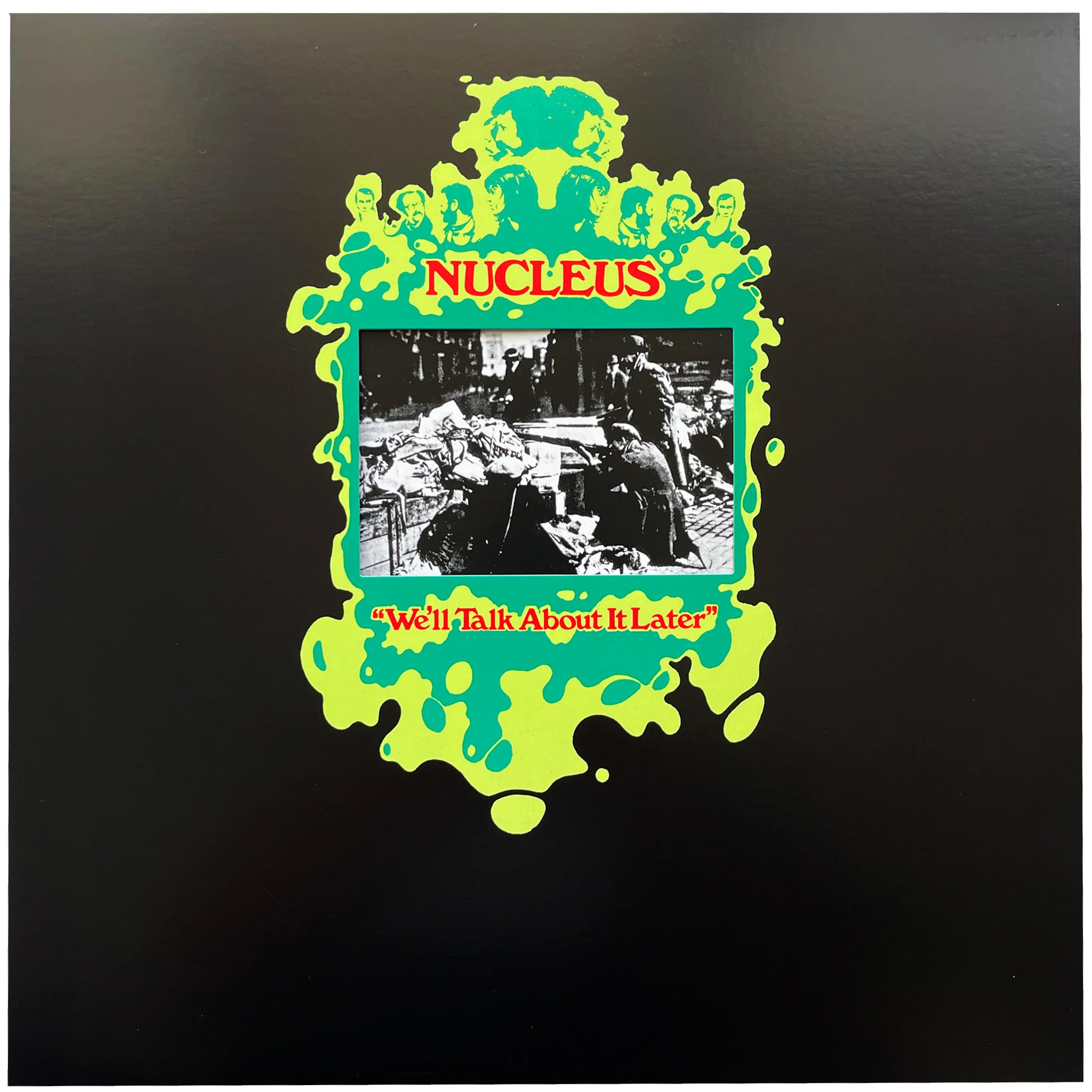
This Be With edition of We’ll Talk About It Later has been re-mastered from the original Vertigo master tapes, Simon Francis’ mastering working together with Cicely Balston’s cut at AIR Studios to weave their usual magic with these wonderful recordings. The stunning die-cut sleeve has been restored with the original gatefold window pane depicting the Irish uprising in 1916. Incredible, timeless, guaranteed spine-chills.
Product Information
Product Information
Shipping & Returns
Shipping & Returns
Nucleus: We'll Talk About It Later 12"
Nucleus: We'll Talk About It Later 12"
Their masterpiece? With breaks for dayyyyyys and an almost ambient, heavy jazz atmosphere throughout, this is the apex of British jazz-rock fusion. We’ll Talk About It Later was first released on Vertigo in 1971 and original copies are now very tricky to score. Like all the Nucleus records, it’s aged ridiculously well and this Be With re-issue, re-mastered from the original analogue tapes, shows off just why this deserves to be back in press.
Genius trumpeter and visionary composer Ian Carr was one of the most respected British musicians of his era. He was a true pioneer and saw the potential in fusing the worlds of jazz with rock, just as Miles Davis and The Tony Williams Lifetime did in the US. In late 1969, following the demise of the Rendell-Carr quintet, and tiring of British jazz, Carr assembled the legendary Nucleus. Regarding music as a continuous process, Nucleus refused to “recognise rigid boundaries” and worked on delivering what they saw as a “total musical experience”. We can get behind that.
Under bandleader Carr, Nucleus existed as a fluid line-up of inventive, skilled musicians. This constant evolution and revolution was all part of the continuous musical exploration and discovery that took jazz to new levels. And the music has kept relevant. To steal a line from a review of our re-issue of Roots, when it comes to anything Nucleus “it’s basically already hip-hop”.
We’ll Talk About It Later is arguably Nucleus’s best album. Not only that, it’s in the top 5 of all fusion albums. By the time Nucleus entered Trident Studios in September 1970 to record Elastic Rock’s successor, they had already won a best group award at the Montreux Jazz Festival. Once again presented in a Roger Dean designed die-cut gatefold sleeve it continued to demonstrate the chemistry and interplay that worked so brilliantly on Elastic Rock; Carr’s sumptuous trumpet and flügelhorn lines, Karl Jenkins’s funk-filled electric keyboards, Chris Spedding’s wah-wah guitar, Brian Smith’s sax and the rhythmic foundation of drummer John Marshall and bassist Jeff Clyne.
The group work and insane musicianship Nucleus were famed for is in evidence from the off. The intensely funky ""Song for the Bearded Lady"" is absolute FIRE, blasting out the speakers to leave listeners floored. Counterpoint riffing segues into a spacious groove and a Carr trumpet solo demonstrating the influence of electric Miles from the period. The stop-start funk of ""Sun Child"" would appeal to Soft Machine devotees whilst the genuinely touching ""Lullaby for a Lonely Child"" is a lovely downtempo ballad. Featuring an understated, reflective horn line from Carr and Smith and atmospheric, shimmering bouzouki from Spedding, there’s an exotic flavour which contributes to the bliss. The ominous, sleazy title track retains a swaggering menace and is not the only track to lend a sort+Q2 of heavy stoner rock atmosphere. The guitars and bass are deep and low throughout, conjuring heavy psych moments to go with the actual jazz and even funk. To say this album was in conversation with Bitches Brew would not be overstating the sheer brain-frying brilliance.
The Weather Report-adjacent ""Oasis"" opens Side B, a colossal track featuring nearly 10 minutes of steadily building melodic horns, keys and choppy guitar riffs. So ace, it could easily go on for another 10. Mesmeric. Spedding adds unique vocals to the undeniable groove of ""Ballad of Joe Pimp"" whilst saxophonist Smith’s duet with drummer Marshall at the conclusion of ""Easter 1916"" – inspired by the Yeats poem about the Irish nationalist uprising in Dublin – adopts the wildness of the most incendiary free jazz.
This Be With edition of We’ll Talk About It Later has been re-mastered from the original Vertigo master tapes, Simon Francis’ mastering working together with Cicely Balston’s cut at AIR Studios to weave their usual magic with these wonderful recordings. The stunning die-cut sleeve has been restored with the original gatefold window pane depicting the Irish uprising in 1916. Incredible, timeless, guaranteed spine-chills.
Original: $58.00
-70%$58.00
$17.40Product Information
Product Information
Shipping & Returns
Shipping & Returns
Description
Their masterpiece? With breaks for dayyyyyys and an almost ambient, heavy jazz atmosphere throughout, this is the apex of British jazz-rock fusion. We’ll Talk About It Later was first released on Vertigo in 1971 and original copies are now very tricky to score. Like all the Nucleus records, it’s aged ridiculously well and this Be With re-issue, re-mastered from the original analogue tapes, shows off just why this deserves to be back in press.
Genius trumpeter and visionary composer Ian Carr was one of the most respected British musicians of his era. He was a true pioneer and saw the potential in fusing the worlds of jazz with rock, just as Miles Davis and The Tony Williams Lifetime did in the US. In late 1969, following the demise of the Rendell-Carr quintet, and tiring of British jazz, Carr assembled the legendary Nucleus. Regarding music as a continuous process, Nucleus refused to “recognise rigid boundaries” and worked on delivering what they saw as a “total musical experience”. We can get behind that.
Under bandleader Carr, Nucleus existed as a fluid line-up of inventive, skilled musicians. This constant evolution and revolution was all part of the continuous musical exploration and discovery that took jazz to new levels. And the music has kept relevant. To steal a line from a review of our re-issue of Roots, when it comes to anything Nucleus “it’s basically already hip-hop”.
We’ll Talk About It Later is arguably Nucleus’s best album. Not only that, it’s in the top 5 of all fusion albums. By the time Nucleus entered Trident Studios in September 1970 to record Elastic Rock’s successor, they had already won a best group award at the Montreux Jazz Festival. Once again presented in a Roger Dean designed die-cut gatefold sleeve it continued to demonstrate the chemistry and interplay that worked so brilliantly on Elastic Rock; Carr’s sumptuous trumpet and flügelhorn lines, Karl Jenkins’s funk-filled electric keyboards, Chris Spedding’s wah-wah guitar, Brian Smith’s sax and the rhythmic foundation of drummer John Marshall and bassist Jeff Clyne.
The group work and insane musicianship Nucleus were famed for is in evidence from the off. The intensely funky ""Song for the Bearded Lady"" is absolute FIRE, blasting out the speakers to leave listeners floored. Counterpoint riffing segues into a spacious groove and a Carr trumpet solo demonstrating the influence of electric Miles from the period. The stop-start funk of ""Sun Child"" would appeal to Soft Machine devotees whilst the genuinely touching ""Lullaby for a Lonely Child"" is a lovely downtempo ballad. Featuring an understated, reflective horn line from Carr and Smith and atmospheric, shimmering bouzouki from Spedding, there’s an exotic flavour which contributes to the bliss. The ominous, sleazy title track retains a swaggering menace and is not the only track to lend a sort+Q2 of heavy stoner rock atmosphere. The guitars and bass are deep and low throughout, conjuring heavy psych moments to go with the actual jazz and even funk. To say this album was in conversation with Bitches Brew would not be overstating the sheer brain-frying brilliance.
The Weather Report-adjacent ""Oasis"" opens Side B, a colossal track featuring nearly 10 minutes of steadily building melodic horns, keys and choppy guitar riffs. So ace, it could easily go on for another 10. Mesmeric. Spedding adds unique vocals to the undeniable groove of ""Ballad of Joe Pimp"" whilst saxophonist Smith’s duet with drummer Marshall at the conclusion of ""Easter 1916"" – inspired by the Yeats poem about the Irish nationalist uprising in Dublin – adopts the wildness of the most incendiary free jazz.
This Be With edition of We’ll Talk About It Later has been re-mastered from the original Vertigo master tapes, Simon Francis’ mastering working together with Cicely Balston’s cut at AIR Studios to weave their usual magic with these wonderful recordings. The stunning die-cut sleeve has been restored with the original gatefold window pane depicting the Irish uprising in 1916. Incredible, timeless, guaranteed spine-chills.