🎉 Up to 70% Off Selected ItemsShop Sale
Spike In Vain: Death Drives A Cadillac 12"
Death Drives A Cadillac was Spike In Vain’s second album, never officially released and unheard in its final form until now. Like many hardcore bands circa ’84 and ’85, the group was ready to further expand its palette and ease off the thrash tempos. Recorded roughly a year after Disease Is Relative with a bigger budget, the album is even more wide-ranging, and the songs are more fleshed out.
“Despair grew inside her, I grew inside her. She named me Spirit Death, and this is my song” sings Chris Marec, the vocalist on half of this LP. Though less “young” than their debut, that album’s darkness lingers, but here has a more removed, observational quality, with many songs sung in character or in the third person, along with a tendency for anthropomorphic allegory. It has a bit less to do with screaming for death to come than with a growing resignation to being the other, a recognition of inescapable alienation and its relation to childhood trauma. —all with a heaping side of absurdity and a sense of wonder at the gradually unfolding endtimes.
That said, many of the tracks wouldn’t be out of place on the debut, and some feature exotic tunings. Bits of roots music come into play as well—gospel, blues, and country figure to some extent in a third of the songs, sometimes in convoluted, Beefheart-esque ways, and at other times toying with genre archetypes as a cat does a mouse.
Our take: Death Drives a Cadillac is the second Spike in Vain album that I never knew existed until I heard about this release on Scat Records. I guess I can forgive myself, because I can’t find any evidence that the recording had been released in any capacity until now. This description is going to assume that you’re already familiar with Spike in Vain’s one proper album, Disease Is Relative, so if you don’t know about that already, read about that album first. Or better yet, just buy it because it is one of the great unheralded punk LPs of the 80s. As someone who has long treasured my copy of Disease Is Relative, I didn’t know what to expect from Death Drives a Cadillac, but I dove in head-first and was rewarded with a great follow-up. Most of the things I love about Spike in Vain are present on Death Drives a Cadillac: the surreal lyrics, knotty rhythms, inventive guitar playing, sinister vibe, great artwork, and—most importantly—the band’s talent for bringing punk energy to a sound that is more or less art rock. I know nothing about the people who comprised Spike in Vain or what they were listening to but my impression is that—like Saccharine Trust, the Meat Puppets, or United Mutation—Spike in Vain was a bunch of arty weirdos who were drawn to hardcore because it was a freak scene. However, by 1984 and 1985, when Spike in Vain recorded Death Drives a Cadillac, the artier end of hardcore had splintered off, the meathead element pushing them toward genres like post-punk and roots music that offered more room for innovation and experimentation. Thus, Death Drives a Cadillac reminds me less of hardcore records and more of bands like the Gun Club, (2nd album and beyond) Meat Puppets, and the Birthday Party, all of whom seemed to value hardcore’s intensity but despised its strict norms. While some of that “post-hardcore” music could sound wimpy or commercial, this is not the case with Death Drives a Cadillac. This is still underground weirdo music, but it’s underground weirdo music with a wider palette and a sense of curiosity about what other emotions and ideas are out there. There isn’t a dud on Death Drives a Cadillac, which is surprising given that it’s a relatively lengthy LP (13 tracks!) and hadn’t been circulated until now. The sound is also great. Scat’s description mentions that these recordings had a bigger budget than Disease Is Relative, but I don’t hear any dodgy 80s production choices. If you already have and love Disease Is Relative, I’m can confirm that Death Drives a Cadillac is well worth your time and attention.
“Despair grew inside her, I grew inside her. She named me Spirit Death, and this is my song” sings Chris Marec, the vocalist on half of this LP. Though less “young” than their debut, that album’s darkness lingers, but here has a more removed, observational quality, with many songs sung in character or in the third person, along with a tendency for anthropomorphic allegory. It has a bit less to do with screaming for death to come than with a growing resignation to being the other, a recognition of inescapable alienation and its relation to childhood trauma. —all with a heaping side of absurdity and a sense of wonder at the gradually unfolding endtimes.
That said, many of the tracks wouldn’t be out of place on the debut, and some feature exotic tunings. Bits of roots music come into play as well—gospel, blues, and country figure to some extent in a third of the songs, sometimes in convoluted, Beefheart-esque ways, and at other times toying with genre archetypes as a cat does a mouse.
Our take: Death Drives a Cadillac is the second Spike in Vain album that I never knew existed until I heard about this release on Scat Records. I guess I can forgive myself, because I can’t find any evidence that the recording had been released in any capacity until now. This description is going to assume that you’re already familiar with Spike in Vain’s one proper album, Disease Is Relative, so if you don’t know about that already, read about that album first. Or better yet, just buy it because it is one of the great unheralded punk LPs of the 80s. As someone who has long treasured my copy of Disease Is Relative, I didn’t know what to expect from Death Drives a Cadillac, but I dove in head-first and was rewarded with a great follow-up. Most of the things I love about Spike in Vain are present on Death Drives a Cadillac: the surreal lyrics, knotty rhythms, inventive guitar playing, sinister vibe, great artwork, and—most importantly—the band’s talent for bringing punk energy to a sound that is more or less art rock. I know nothing about the people who comprised Spike in Vain or what they were listening to but my impression is that—like Saccharine Trust, the Meat Puppets, or United Mutation—Spike in Vain was a bunch of arty weirdos who were drawn to hardcore because it was a freak scene. However, by 1984 and 1985, when Spike in Vain recorded Death Drives a Cadillac, the artier end of hardcore had splintered off, the meathead element pushing them toward genres like post-punk and roots music that offered more room for innovation and experimentation. Thus, Death Drives a Cadillac reminds me less of hardcore records and more of bands like the Gun Club, (2nd album and beyond) Meat Puppets, and the Birthday Party, all of whom seemed to value hardcore’s intensity but despised its strict norms. While some of that “post-hardcore” music could sound wimpy or commercial, this is not the case with Death Drives a Cadillac. This is still underground weirdo music, but it’s underground weirdo music with a wider palette and a sense of curiosity about what other emotions and ideas are out there. There isn’t a dud on Death Drives a Cadillac, which is surprising given that it’s a relatively lengthy LP (13 tracks!) and hadn’t been circulated until now. The sound is also great. Scat’s description mentions that these recordings had a bigger budget than Disease Is Relative, but I don’t hear any dodgy 80s production choices. If you already have and love Disease Is Relative, I’m can confirm that Death Drives a Cadillac is well worth your time and attention.
Product Information
Product Information
Shipping & Returns
Shipping & Returns
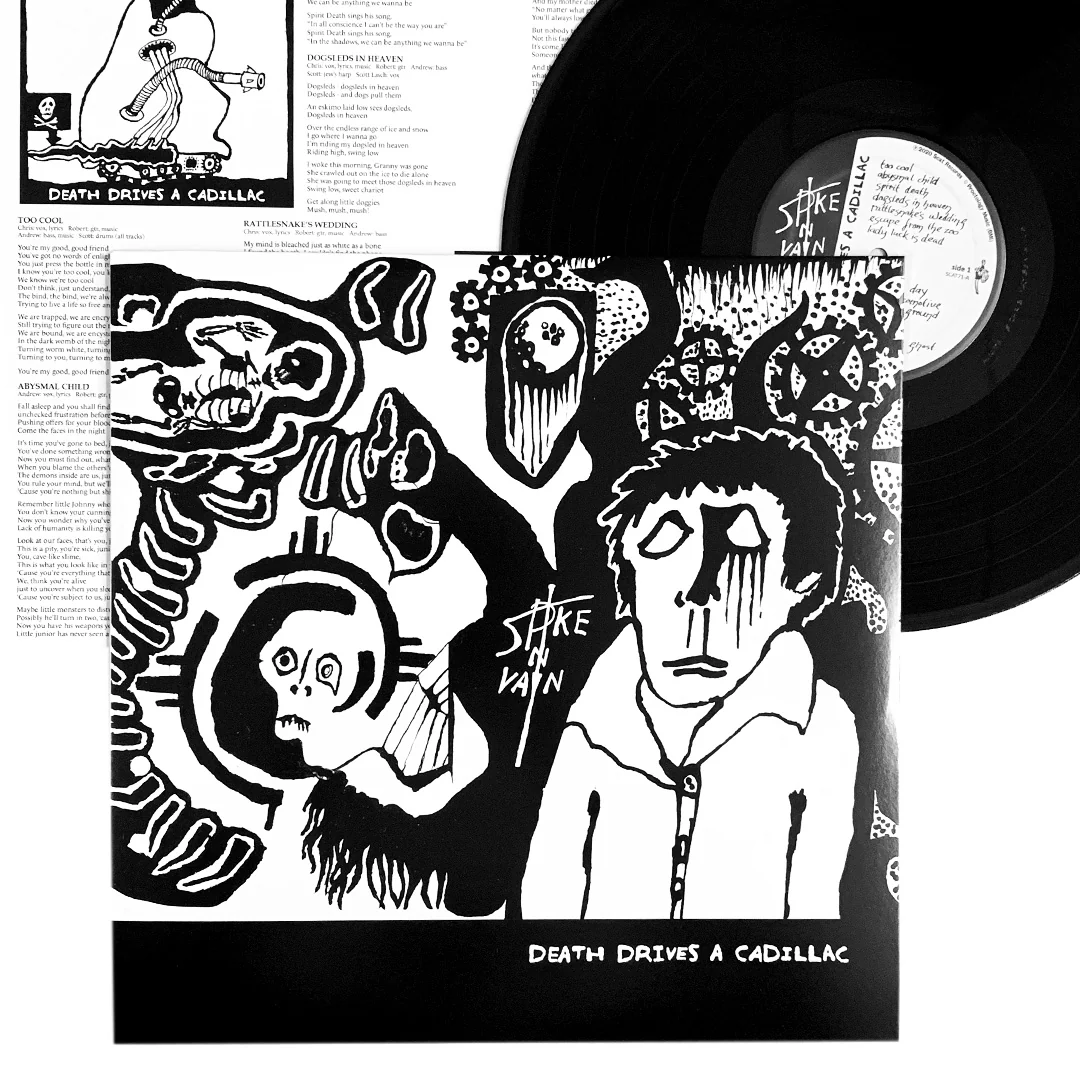
Spike In Vain: Death Drives A Cadillac 12"
Spike In Vain: Death Drives A Cadillac 12"
Death Drives A Cadillac was Spike In Vain’s second album, never officially released and unheard in its final form until now. Like many hardcore bands circa ’84 and ’85, the group was ready to further expand its palette and ease off the thrash tempos. Recorded roughly a year after Disease Is Relative with a bigger budget, the album is even more wide-ranging, and the songs are more fleshed out.
“Despair grew inside her, I grew inside her. She named me Spirit Death, and this is my song” sings Chris Marec, the vocalist on half of this LP. Though less “young” than their debut, that album’s darkness lingers, but here has a more removed, observational quality, with many songs sung in character or in the third person, along with a tendency for anthropomorphic allegory. It has a bit less to do with screaming for death to come than with a growing resignation to being the other, a recognition of inescapable alienation and its relation to childhood trauma. —all with a heaping side of absurdity and a sense of wonder at the gradually unfolding endtimes.
That said, many of the tracks wouldn’t be out of place on the debut, and some feature exotic tunings. Bits of roots music come into play as well—gospel, blues, and country figure to some extent in a third of the songs, sometimes in convoluted, Beefheart-esque ways, and at other times toying with genre archetypes as a cat does a mouse.
Our take: Death Drives a Cadillac is the second Spike in Vain album that I never knew existed until I heard about this release on Scat Records. I guess I can forgive myself, because I can’t find any evidence that the recording had been released in any capacity until now. This description is going to assume that you’re already familiar with Spike in Vain’s one proper album, Disease Is Relative, so if you don’t know about that already, read about that album first. Or better yet, just buy it because it is one of the great unheralded punk LPs of the 80s. As someone who has long treasured my copy of Disease Is Relative, I didn’t know what to expect from Death Drives a Cadillac, but I dove in head-first and was rewarded with a great follow-up. Most of the things I love about Spike in Vain are present on Death Drives a Cadillac: the surreal lyrics, knotty rhythms, inventive guitar playing, sinister vibe, great artwork, and—most importantly—the band’s talent for bringing punk energy to a sound that is more or less art rock. I know nothing about the people who comprised Spike in Vain or what they were listening to but my impression is that—like Saccharine Trust, the Meat Puppets, or United Mutation—Spike in Vain was a bunch of arty weirdos who were drawn to hardcore because it was a freak scene. However, by 1984 and 1985, when Spike in Vain recorded Death Drives a Cadillac, the artier end of hardcore had splintered off, the meathead element pushing them toward genres like post-punk and roots music that offered more room for innovation and experimentation. Thus, Death Drives a Cadillac reminds me less of hardcore records and more of bands like the Gun Club, (2nd album and beyond) Meat Puppets, and the Birthday Party, all of whom seemed to value hardcore’s intensity but despised its strict norms. While some of that “post-hardcore” music could sound wimpy or commercial, this is not the case with Death Drives a Cadillac. This is still underground weirdo music, but it’s underground weirdo music with a wider palette and a sense of curiosity about what other emotions and ideas are out there. There isn’t a dud on Death Drives a Cadillac, which is surprising given that it’s a relatively lengthy LP (13 tracks!) and hadn’t been circulated until now. The sound is also great. Scat’s description mentions that these recordings had a bigger budget than Disease Is Relative, but I don’t hear any dodgy 80s production choices. If you already have and love Disease Is Relative, I’m can confirm that Death Drives a Cadillac is well worth your time and attention.
“Despair grew inside her, I grew inside her. She named me Spirit Death, and this is my song” sings Chris Marec, the vocalist on half of this LP. Though less “young” than their debut, that album’s darkness lingers, but here has a more removed, observational quality, with many songs sung in character or in the third person, along with a tendency for anthropomorphic allegory. It has a bit less to do with screaming for death to come than with a growing resignation to being the other, a recognition of inescapable alienation and its relation to childhood trauma. —all with a heaping side of absurdity and a sense of wonder at the gradually unfolding endtimes.
That said, many of the tracks wouldn’t be out of place on the debut, and some feature exotic tunings. Bits of roots music come into play as well—gospel, blues, and country figure to some extent in a third of the songs, sometimes in convoluted, Beefheart-esque ways, and at other times toying with genre archetypes as a cat does a mouse.
Our take: Death Drives a Cadillac is the second Spike in Vain album that I never knew existed until I heard about this release on Scat Records. I guess I can forgive myself, because I can’t find any evidence that the recording had been released in any capacity until now. This description is going to assume that you’re already familiar with Spike in Vain’s one proper album, Disease Is Relative, so if you don’t know about that already, read about that album first. Or better yet, just buy it because it is one of the great unheralded punk LPs of the 80s. As someone who has long treasured my copy of Disease Is Relative, I didn’t know what to expect from Death Drives a Cadillac, but I dove in head-first and was rewarded with a great follow-up. Most of the things I love about Spike in Vain are present on Death Drives a Cadillac: the surreal lyrics, knotty rhythms, inventive guitar playing, sinister vibe, great artwork, and—most importantly—the band’s talent for bringing punk energy to a sound that is more or less art rock. I know nothing about the people who comprised Spike in Vain or what they were listening to but my impression is that—like Saccharine Trust, the Meat Puppets, or United Mutation—Spike in Vain was a bunch of arty weirdos who were drawn to hardcore because it was a freak scene. However, by 1984 and 1985, when Spike in Vain recorded Death Drives a Cadillac, the artier end of hardcore had splintered off, the meathead element pushing them toward genres like post-punk and roots music that offered more room for innovation and experimentation. Thus, Death Drives a Cadillac reminds me less of hardcore records and more of bands like the Gun Club, (2nd album and beyond) Meat Puppets, and the Birthday Party, all of whom seemed to value hardcore’s intensity but despised its strict norms. While some of that “post-hardcore” music could sound wimpy or commercial, this is not the case with Death Drives a Cadillac. This is still underground weirdo music, but it’s underground weirdo music with a wider palette and a sense of curiosity about what other emotions and ideas are out there. There isn’t a dud on Death Drives a Cadillac, which is surprising given that it’s a relatively lengthy LP (13 tracks!) and hadn’t been circulated until now. The sound is also great. Scat’s description mentions that these recordings had a bigger budget than Disease Is Relative, but I don’t hear any dodgy 80s production choices. If you already have and love Disease Is Relative, I’m can confirm that Death Drives a Cadillac is well worth your time and attention.
$356.70
Original: $1,189.00
-70%Spike In Vain: Death Drives A Cadillac 12"—
$1,189.00
$356.70Product Information
Product Information
Shipping & Returns
Shipping & Returns
Description
Death Drives A Cadillac was Spike In Vain’s second album, never officially released and unheard in its final form until now. Like many hardcore bands circa ’84 and ’85, the group was ready to further expand its palette and ease off the thrash tempos. Recorded roughly a year after Disease Is Relative with a bigger budget, the album is even more wide-ranging, and the songs are more fleshed out.
“Despair grew inside her, I grew inside her. She named me Spirit Death, and this is my song” sings Chris Marec, the vocalist on half of this LP. Though less “young” than their debut, that album’s darkness lingers, but here has a more removed, observational quality, with many songs sung in character or in the third person, along with a tendency for anthropomorphic allegory. It has a bit less to do with screaming for death to come than with a growing resignation to being the other, a recognition of inescapable alienation and its relation to childhood trauma. —all with a heaping side of absurdity and a sense of wonder at the gradually unfolding endtimes.
That said, many of the tracks wouldn’t be out of place on the debut, and some feature exotic tunings. Bits of roots music come into play as well—gospel, blues, and country figure to some extent in a third of the songs, sometimes in convoluted, Beefheart-esque ways, and at other times toying with genre archetypes as a cat does a mouse.
Our take: Death Drives a Cadillac is the second Spike in Vain album that I never knew existed until I heard about this release on Scat Records. I guess I can forgive myself, because I can’t find any evidence that the recording had been released in any capacity until now. This description is going to assume that you’re already familiar with Spike in Vain’s one proper album, Disease Is Relative, so if you don’t know about that already, read about that album first. Or better yet, just buy it because it is one of the great unheralded punk LPs of the 80s. As someone who has long treasured my copy of Disease Is Relative, I didn’t know what to expect from Death Drives a Cadillac, but I dove in head-first and was rewarded with a great follow-up. Most of the things I love about Spike in Vain are present on Death Drives a Cadillac: the surreal lyrics, knotty rhythms, inventive guitar playing, sinister vibe, great artwork, and—most importantly—the band’s talent for bringing punk energy to a sound that is more or less art rock. I know nothing about the people who comprised Spike in Vain or what they were listening to but my impression is that—like Saccharine Trust, the Meat Puppets, or United Mutation—Spike in Vain was a bunch of arty weirdos who were drawn to hardcore because it was a freak scene. However, by 1984 and 1985, when Spike in Vain recorded Death Drives a Cadillac, the artier end of hardcore had splintered off, the meathead element pushing them toward genres like post-punk and roots music that offered more room for innovation and experimentation. Thus, Death Drives a Cadillac reminds me less of hardcore records and more of bands like the Gun Club, (2nd album and beyond) Meat Puppets, and the Birthday Party, all of whom seemed to value hardcore’s intensity but despised its strict norms. While some of that “post-hardcore” music could sound wimpy or commercial, this is not the case with Death Drives a Cadillac. This is still underground weirdo music, but it’s underground weirdo music with a wider palette and a sense of curiosity about what other emotions and ideas are out there. There isn’t a dud on Death Drives a Cadillac, which is surprising given that it’s a relatively lengthy LP (13 tracks!) and hadn’t been circulated until now. The sound is also great. Scat’s description mentions that these recordings had a bigger budget than Disease Is Relative, but I don’t hear any dodgy 80s production choices. If you already have and love Disease Is Relative, I’m can confirm that Death Drives a Cadillac is well worth your time and attention.
“Despair grew inside her, I grew inside her. She named me Spirit Death, and this is my song” sings Chris Marec, the vocalist on half of this LP. Though less “young” than their debut, that album’s darkness lingers, but here has a more removed, observational quality, with many songs sung in character or in the third person, along with a tendency for anthropomorphic allegory. It has a bit less to do with screaming for death to come than with a growing resignation to being the other, a recognition of inescapable alienation and its relation to childhood trauma. —all with a heaping side of absurdity and a sense of wonder at the gradually unfolding endtimes.
That said, many of the tracks wouldn’t be out of place on the debut, and some feature exotic tunings. Bits of roots music come into play as well—gospel, blues, and country figure to some extent in a third of the songs, sometimes in convoluted, Beefheart-esque ways, and at other times toying with genre archetypes as a cat does a mouse.
Our take: Death Drives a Cadillac is the second Spike in Vain album that I never knew existed until I heard about this release on Scat Records. I guess I can forgive myself, because I can’t find any evidence that the recording had been released in any capacity until now. This description is going to assume that you’re already familiar with Spike in Vain’s one proper album, Disease Is Relative, so if you don’t know about that already, read about that album first. Or better yet, just buy it because it is one of the great unheralded punk LPs of the 80s. As someone who has long treasured my copy of Disease Is Relative, I didn’t know what to expect from Death Drives a Cadillac, but I dove in head-first and was rewarded with a great follow-up. Most of the things I love about Spike in Vain are present on Death Drives a Cadillac: the surreal lyrics, knotty rhythms, inventive guitar playing, sinister vibe, great artwork, and—most importantly—the band’s talent for bringing punk energy to a sound that is more or less art rock. I know nothing about the people who comprised Spike in Vain or what they were listening to but my impression is that—like Saccharine Trust, the Meat Puppets, or United Mutation—Spike in Vain was a bunch of arty weirdos who were drawn to hardcore because it was a freak scene. However, by 1984 and 1985, when Spike in Vain recorded Death Drives a Cadillac, the artier end of hardcore had splintered off, the meathead element pushing them toward genres like post-punk and roots music that offered more room for innovation and experimentation. Thus, Death Drives a Cadillac reminds me less of hardcore records and more of bands like the Gun Club, (2nd album and beyond) Meat Puppets, and the Birthday Party, all of whom seemed to value hardcore’s intensity but despised its strict norms. While some of that “post-hardcore” music could sound wimpy or commercial, this is not the case with Death Drives a Cadillac. This is still underground weirdo music, but it’s underground weirdo music with a wider palette and a sense of curiosity about what other emotions and ideas are out there. There isn’t a dud on Death Drives a Cadillac, which is surprising given that it’s a relatively lengthy LP (13 tracks!) and hadn’t been circulated until now. The sound is also great. Scat’s description mentions that these recordings had a bigger budget than Disease Is Relative, but I don’t hear any dodgy 80s production choices. If you already have and love Disease Is Relative, I’m can confirm that Death Drives a Cadillac is well worth your time and attention.