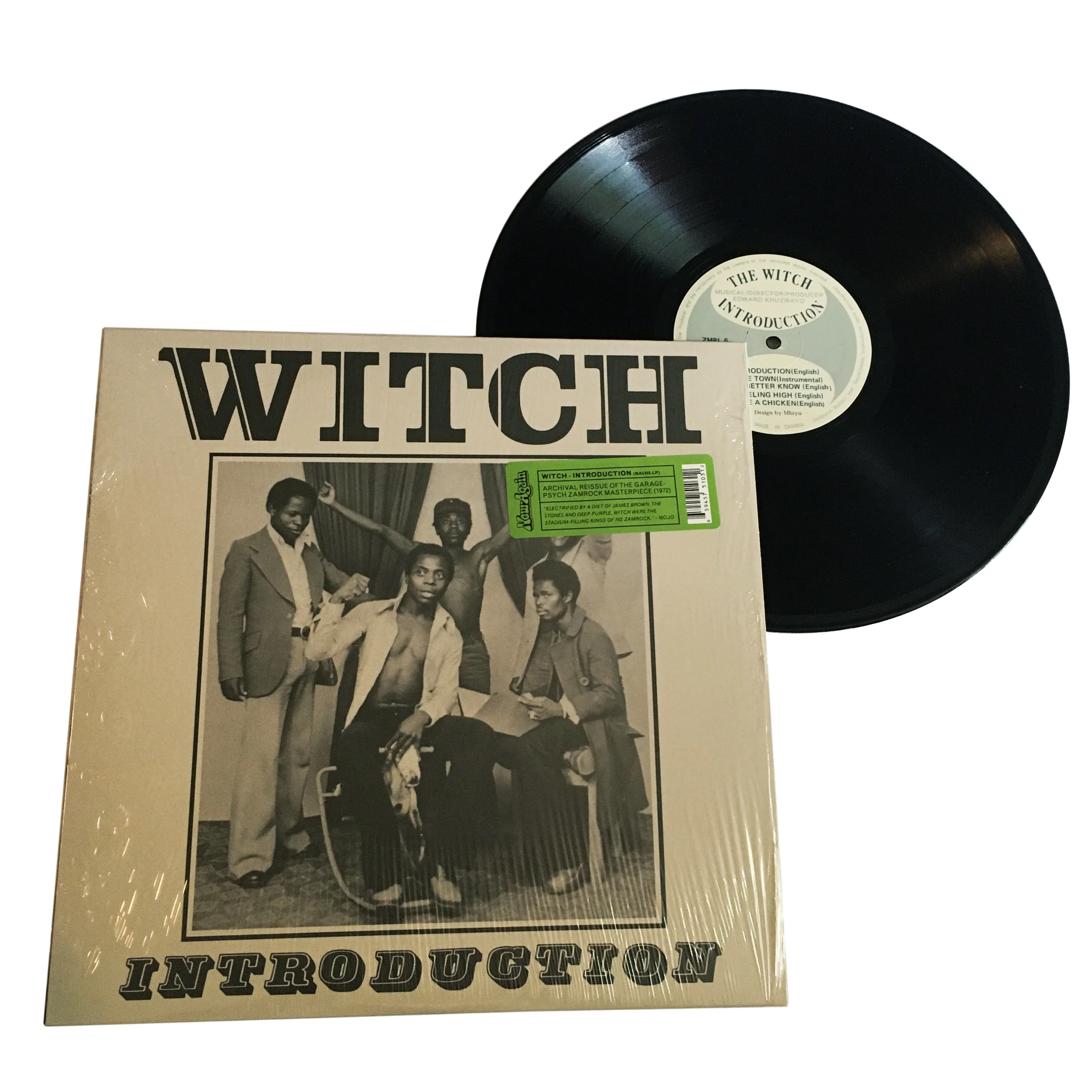
Witch: Introduction 12"
By the mid 1970s, the Southern African nation known as the Republic of Zambia had fallen on hard times. The new Federation found itself under party rule. Zambia’s then-president engaged what was then Southern Rhodesia (now Zimbabwe) in a political fencing match that damaged his country’s ability to trade with its main partner. The Portuguese colonies of Angola to the West and Mozambique to the East were fighting their own battles for independence; conflict loomed on all sides of this landlocked nation.
This is the environment in which the catchy – if misleadingly – titled “Zam Rock” scene that flourished in 1970s Zambian cities such as Lusaka and Chingola emerged. Though full of beacons of hope for its numerous musical hopeful it was a tumultuous time and it’s no wonder that the Zambian musicians taken by European and English influences gravitated to the hard, dark side of the rock and funk spectrum.
From the little of the Zambian 70s rock and funk music that has been spread via small blogs and bootlegs – the likes of Chrissy Zebby, Paul Ngozi and the Ngozi Family, and the devastating Peace – we learn that fuzz guitars were commonplace, driving rhythms as influenced by James Brown’s funk as Jimi Hendrix’s rock predominated, and the bands largely sang in the country’s national language, English.
The European and North American compilers that had, say, fallen in love with the wonders of Nigeria’s 70s scene via an introduction by Afro-Beat maestro Fela Kuti and decided to journey to Lagos to investigate further never even bothered to visit Zambia. Perhaps this is because even the largest of the 70s Zambian recording artists made any impact on the global scale.
Before 2000 – and infrequently since then – few Europeans or North Americans outside of university-funded ethnomusicologists more interested in the country’s folk musics than its pop culture even journeyed to this country in search of a the progenitors of the Zam Rock scene. And, when they did, the markers were few. Only a small number of the original Zam Rock godfathers that remained in the country survived through the late 90s, when the music recorded in Zambia became the next frontier for those global-psychedelic rock junkies searching for the next fix.
Now-Again, in conjunction with Zam Rock pioneer Rikki Ililonga, has licensed the Witch repertoire from the ensemble’s last surviving member, Emmanuel Jagari Canda, and the Amanaz Africa album from the band’s Keith Kabwe and Issac Mpofu. Witch's musical arc is contained to a five year span and, in retrospect, is a logical one.
The band's first two, self-produced albums - released in unison with the birth of the commercial Zambian recording industry - are exuberant experiments in garage rock, and are as influenced by the Rolling Stones as they are James Brown. Thus 1973's Introduction, their first, is the perfect starting point for anyone interested in delving into the Witch band, or Zamrock in general.
Product Information
Product Information
Shipping & Returns
Shipping & Returns
Witch: Introduction 12"
Witch: Introduction 12"
By the mid 1970s, the Southern African nation known as the Republic of Zambia had fallen on hard times. The new Federation found itself under party rule. Zambia’s then-president engaged what was then Southern Rhodesia (now Zimbabwe) in a political fencing match that damaged his country’s ability to trade with its main partner. The Portuguese colonies of Angola to the West and Mozambique to the East were fighting their own battles for independence; conflict loomed on all sides of this landlocked nation.
This is the environment in which the catchy – if misleadingly – titled “Zam Rock” scene that flourished in 1970s Zambian cities such as Lusaka and Chingola emerged. Though full of beacons of hope for its numerous musical hopeful it was a tumultuous time and it’s no wonder that the Zambian musicians taken by European and English influences gravitated to the hard, dark side of the rock and funk spectrum.
From the little of the Zambian 70s rock and funk music that has been spread via small blogs and bootlegs – the likes of Chrissy Zebby, Paul Ngozi and the Ngozi Family, and the devastating Peace – we learn that fuzz guitars were commonplace, driving rhythms as influenced by James Brown’s funk as Jimi Hendrix’s rock predominated, and the bands largely sang in the country’s national language, English.
The European and North American compilers that had, say, fallen in love with the wonders of Nigeria’s 70s scene via an introduction by Afro-Beat maestro Fela Kuti and decided to journey to Lagos to investigate further never even bothered to visit Zambia. Perhaps this is because even the largest of the 70s Zambian recording artists made any impact on the global scale.
Before 2000 – and infrequently since then – few Europeans or North Americans outside of university-funded ethnomusicologists more interested in the country’s folk musics than its pop culture even journeyed to this country in search of a the progenitors of the Zam Rock scene. And, when they did, the markers were few. Only a small number of the original Zam Rock godfathers that remained in the country survived through the late 90s, when the music recorded in Zambia became the next frontier for those global-psychedelic rock junkies searching for the next fix.
Now-Again, in conjunction with Zam Rock pioneer Rikki Ililonga, has licensed the Witch repertoire from the ensemble’s last surviving member, Emmanuel Jagari Canda, and the Amanaz Africa album from the band’s Keith Kabwe and Issac Mpofu. Witch's musical arc is contained to a five year span and, in retrospect, is a logical one.
The band's first two, self-produced albums - released in unison with the birth of the commercial Zambian recording industry - are exuberant experiments in garage rock, and are as influenced by the Rolling Stones as they are James Brown. Thus 1973's Introduction, their first, is the perfect starting point for anyone interested in delving into the Witch band, or Zamrock in general.
Original: $31.00
-70%$31.00
$9.30Product Information
Product Information
Shipping & Returns
Shipping & Returns
Description
By the mid 1970s, the Southern African nation known as the Republic of Zambia had fallen on hard times. The new Federation found itself under party rule. Zambia’s then-president engaged what was then Southern Rhodesia (now Zimbabwe) in a political fencing match that damaged his country’s ability to trade with its main partner. The Portuguese colonies of Angola to the West and Mozambique to the East were fighting their own battles for independence; conflict loomed on all sides of this landlocked nation.
This is the environment in which the catchy – if misleadingly – titled “Zam Rock” scene that flourished in 1970s Zambian cities such as Lusaka and Chingola emerged. Though full of beacons of hope for its numerous musical hopeful it was a tumultuous time and it’s no wonder that the Zambian musicians taken by European and English influences gravitated to the hard, dark side of the rock and funk spectrum.
From the little of the Zambian 70s rock and funk music that has been spread via small blogs and bootlegs – the likes of Chrissy Zebby, Paul Ngozi and the Ngozi Family, and the devastating Peace – we learn that fuzz guitars were commonplace, driving rhythms as influenced by James Brown’s funk as Jimi Hendrix’s rock predominated, and the bands largely sang in the country’s national language, English.
The European and North American compilers that had, say, fallen in love with the wonders of Nigeria’s 70s scene via an introduction by Afro-Beat maestro Fela Kuti and decided to journey to Lagos to investigate further never even bothered to visit Zambia. Perhaps this is because even the largest of the 70s Zambian recording artists made any impact on the global scale.
Before 2000 – and infrequently since then – few Europeans or North Americans outside of university-funded ethnomusicologists more interested in the country’s folk musics than its pop culture even journeyed to this country in search of a the progenitors of the Zam Rock scene. And, when they did, the markers were few. Only a small number of the original Zam Rock godfathers that remained in the country survived through the late 90s, when the music recorded in Zambia became the next frontier for those global-psychedelic rock junkies searching for the next fix.
Now-Again, in conjunction with Zam Rock pioneer Rikki Ililonga, has licensed the Witch repertoire from the ensemble’s last surviving member, Emmanuel Jagari Canda, and the Amanaz Africa album from the band’s Keith Kabwe and Issac Mpofu. Witch's musical arc is contained to a five year span and, in retrospect, is a logical one.
The band's first two, self-produced albums - released in unison with the birth of the commercial Zambian recording industry - are exuberant experiments in garage rock, and are as influenced by the Rolling Stones as they are James Brown. Thus 1973's Introduction, their first, is the perfect starting point for anyone interested in delving into the Witch band, or Zamrock in general.